
Rubberwood appears in many affordable products, but the name can make people question whether it is real wood, a weaker substitute, or a material that will hold up in daily use.
Rubberwood is a real hardwood from the rubber tree, usually harvested after the tree’s latex-producing life ends. Understanding its source, appearance, uses, strengths, and limits makes it easier to judge when rubberwood is suitable for furniture or other household products.
I. What Is Rubberwood and Where Does It Come From?
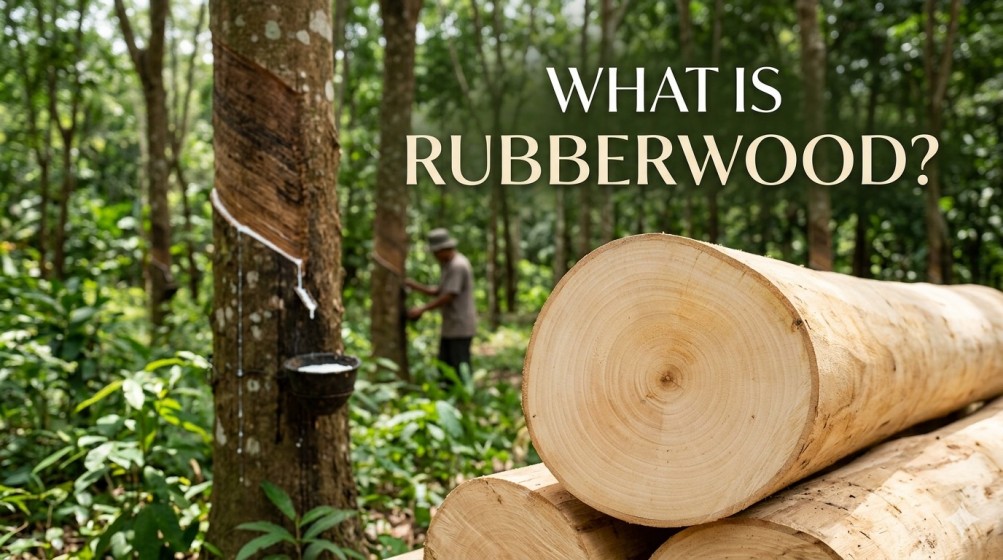
Rubberwood is a real hardwood that comes from the rubber tree, usually after the tree is no longer productive for latex harvesting. This makes rubberwood different from many forest-cut hardwoods because it is linked to an existing agricultural cycle. For readers asking “what is rubberwood”, the first useful answer is simple: it is a practical, light-colored wood material, not plastic, rubber, or imitation board.
1. Rubberwood Comes from the Para Rubber Tree
Rubberwood comes from the Para rubber tree, also known as Hevea brasiliensis. These trees are first used for latex, and the wood becomes useful later when latex production is no longer the main value.
The source is easy to remember:
- Real tree
- Latex first
- Timber later
- Indoor use
- Light color
2. Why Rubberwood Is Used After Latex Production
Rubberwood became widely used because it gives value to trees that would otherwise have limited use after their latex cycle. Instead of treating old rubber trees as waste, producers can process the timber into usable wood for furniture, household products, and other indoor applications.
This table keeps the basic judgment clear:
| Question | Practical Answer | Reader Judgment |
|---|---|---|
| Is it real wood? | Yes, from a rubber tree | Natural timber |
| Is it rubber? | No, only the tree source is related | Do not confuse the material |
| Why use it? | It adds value after latex production | Resource-efficient |
| Is quality automatic? | No, processing still matters | Check the finished product |
Key Takeaway: Rubberwood is a real hardwood from rubber trees, but product quality still depends on processing.
II. Is Rubberwood Real, Solid, or Hardwood?
1. Is Rubberwood Real Wood?
Rubberwood is real wood, and it is also classified as a hardwood because it comes from a broadleaf rubber tree. The phrase “what is rubberwood” often appears because people confuse the name with rubber or low-grade substitutes. The more useful question is whether a product uses solid rubberwood, finger-jointed rubberwood, veneer, or another board core.
Rubberwood is a natural wood, not synthetic rubber or a plastic-based material. It comes from the trunk of the rubber tree and can be sawn, dried, machined, sanded, stained, and finished like other furniture woods.
This distinction helps avoid common material confusion:
- Real wood
- Tree-based
- Not rubber
- Not plastic
- Not MDF
2. Is Rubberwood Solid Wood?
Rubberwood can be solid wood, but finished products may use different structures. Solid rubberwood pieces, finger-jointed boards, rubberwood veneer, MDF, plywood, and particle board do not mean the same thing, so the product description matters more than the wood name alone.
3. Is Rubberwood a Hardwood?
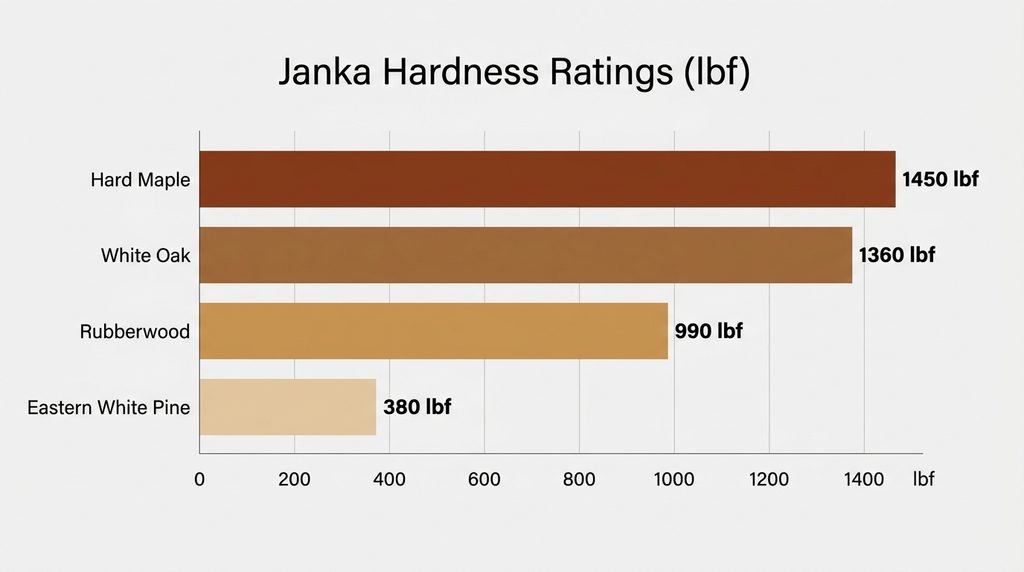
Rubberwood is a hardwood in botanical terms because it comes from a broadleaf tree, not a needle-leaf softwood tree. However, “hardwood” does not automatically mean the hardest or most dent-resistant wood, so daily performance still depends on density, surface finish, structure, and use conditions.
The table below separates the main material terms readers often mix together:
| Material Term | What It Means | Reader Judgment |
|---|---|---|
| Real wood | Wood from a natural tree | Yes, rubberwood qualifies |
| Solid rubberwood | Solid pieces or joined rubberwood boards | Check product structure |
| Hardwood | Botanical wood category | Rubberwood qualifies |
| MDF or particle board | Engineered board, not solid rubberwood | Different material |
| Veneer | Thin wood layer over another core | Needs clear description |
Key Takeaway: Rubberwood is a real hardwood, but the finished product’s structure still needs clear confirmation.
III. What Does Rubberwood Look Like?
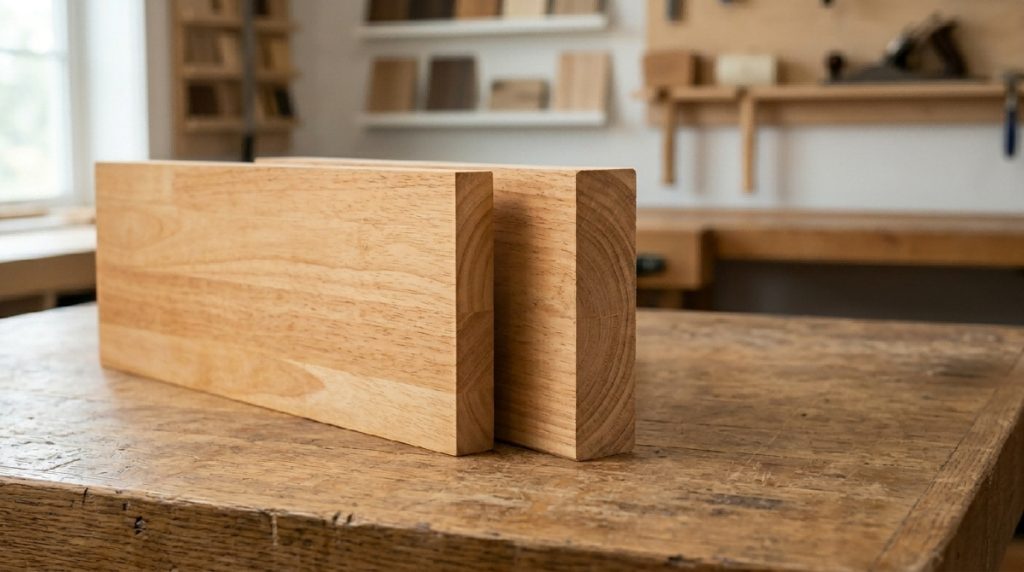
Rubberwood usually has a light, warm appearance with a simple grain pattern, which is one reason it is common in indoor products. When people ask “what is rubberwood”, appearance matters because the material often looks cleaner and more neutral than stronger-grained woods. Its visual character works best when the buyer wants a calm wood tone rather than a dramatic natural pattern.
1. Natural Color and Grain Pattern
Rubberwood is usually pale blonde, cream, or light tan before finishing. The grain is generally straight and modest, so the surface tends to look even instead of heavily patterned.
Its appearance is easy to recognize through a few visual cues:
- Light tone
- Simple grain
- Low contrast
- Smooth background
- Easy color matching
2. Why Rubberwood Looks Even and Light
Rubberwood often looks visually consistent because its grain is not as bold as oak, walnut, or ash. This makes it suitable for clear finishes, soft stains, painted surfaces, and modern interiors where a quiet wood surface is preferred.
The table below shows how rubberwood’s look affects product and finish choices:
| Visual Feature | What It Means | Best Judgment |
|---|---|---|
| Light natural color | Easy to brighten or darken | Good for flexible finishes |
| Straight grain | Less dramatic wood pattern | Suitable for clean designs |
| Low contrast | More uniform surface | Good for matching sets |
| Mild natural variation | Not fully identical piece to piece | Confirm sample appearance |
| Smooth finished look | Works well with sanding and coating | Check finish quality |
Key Takeaway: Rubberwood has a light, simple look that works best when visual consistency matters.
IV. What Are the Main Properties of Rubberwood?
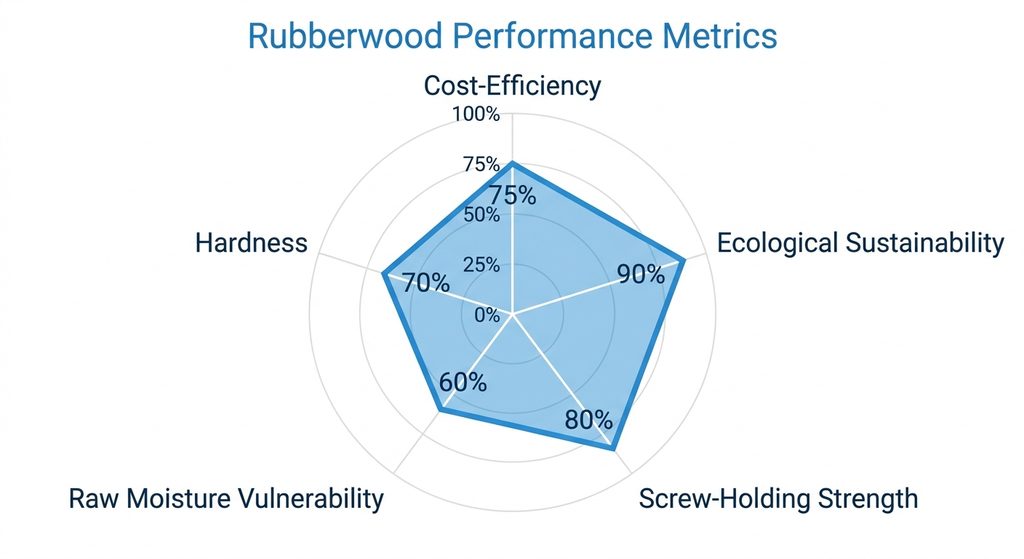
Rubberwood is a medium-density hardwood with a practical balance of workability, surface smoothness, and indoor durability. For readers trying to understand “what is rubberwood” beyond its name, the key is to judge it as an indoor-use wood with useful strength, moderate hardness, and limits under moisture exposure. It performs best when drying, joining, and finishing are properly controlled.
1. Density, Strength, and Everyday Durability
Rubberwood has enough density for many indoor products, especially furniture parts, household items, and surfaces that need a clean finished look. It is not usually selected as a luxury hardwood, but it can perform well in daily-use products when the structure matches the application.
Its main performance points are simple:
- Medium density
- Indoor strength
- Smooth machining
- Moderate dent resistance
- Moisture-sensitive limits
2. Finger-Jointed Construction in Larger Boards
Rubberwood is often joined into larger boards because the available timber pieces are commonly processed into smaller sections. Finger-jointed or laminated panels can be suitable for furniture, but the final result depends on glue quality, board matching, moisture control, and whether the product is used in the right environment.
The table below shows how each property affects product judgment:
| Property | What It Means | Reader Judgment |
|---|---|---|
| Medium density | Strong enough for many indoor uses | Acceptable for daily products |
| Smooth machining | Easy to cut, sand, and shape | Good for clean finishes |
| Moderate hardness | Can handle normal use, but may dent | Confirm use intensity |
| Joined panels | Common in larger boards | Check joint quality |
| Moisture sensitivity | Not ideal for damp exposure | Avoid wet or outdoor use |
Key Takeaway: Rubberwood performs well indoors when the structure, joints, and finish match the product’s use.
V. Why Is Rubberwood Considered Sustainable?
Rubberwood is considered sustainable because it uses timber from rubber trees after their main latex-producing value has declined. This matters when people ask “what is rubberwood” because the material is not usually understood by strength or appearance. Its environmental value comes from using an existing plantation resource, although responsible processing and sourcing still need confirmation.
1. It Uses Trees After Latex Production
Rubberwood gives a second use to trees that were first grown for latex. Instead of relying only on forest-cut hardwoods, producers can turn retired rubber trees into boards, panels, furniture parts, and household products.
The sustainability logic is easy to remember:
- Latex first
- Timber later
- Plantation source
- Less waste
- Processing still matters
2. Why Sustainability Still Needs Checking
Rubberwood’s resource-efficient origin does not automatically make every finished product responsible. The final judgment still depends on how the timber is dried, treated, glued, finished, packaged, and documented for the target market.
This table separates the material advantage from the product-level checks:
| Sustainability Point | What It Means | Reader Judgment |
|---|---|---|
| Plantation origin | Comes from managed rubber trees | Positive material source |
| Post-latex use | Adds value after latex production | Resource-efficient |
| Processing quality | Drying and treatment still matter | Needs confirmation |
| Finish and glue | Coatings affect final safety | Check product details |
| Documentation | Claims need support | Ask for clear records |
Key Takeaway: Rubberwood has a strong resource story, but the finished product responsibility still needs evidence.
VI. What Is Rubberwood Used For?
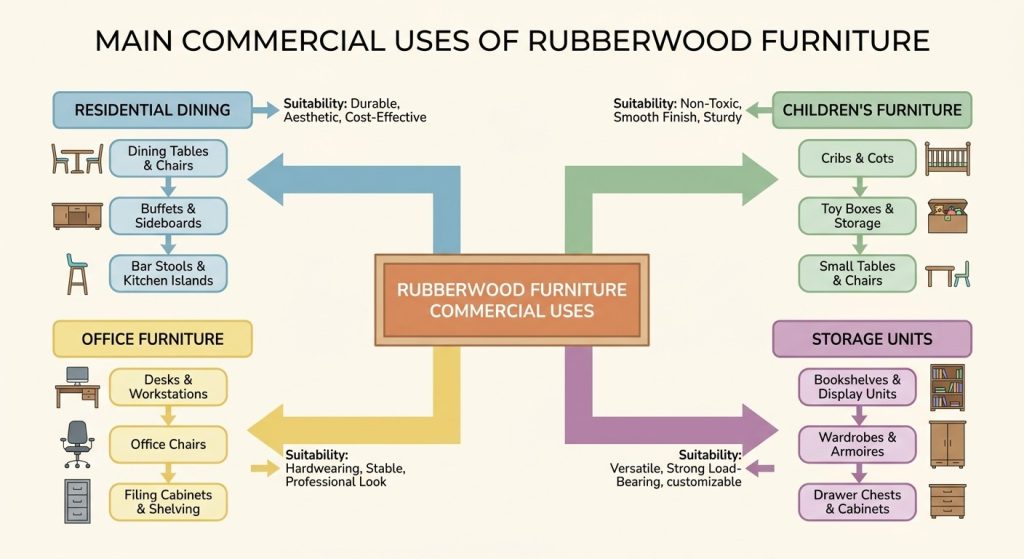
Rubberwood is used for indoor furniture, household products, kitchen items, toys, and other wood-based products that need a clean look and workable structure. When answering “what is rubberwood”, uses matter because they show the material’s practical range. Its strongest fit is usually indoor use, where moisture exposure can be controlled.
1. Indoor Furniture Uses
Rubberwood is commonly used in tables, chairs, cabinets, shelves, bed frames, and other indoor furniture pieces. Its light color, workable grain, and moderate strength make it suitable for many products where a solid wood feel and controlled cost both matter.
Its furniture uses are easiest to group by function:
- Table tops
- Chair frames
- Cabinet panels
- Shelving parts
- Bed components
2. Kitchenware, Toys, Flooring, and Other Uses
Rubberwood can also be used for cutting boards, kitchen accessories, children’s toys, small home items, and some flooring applications. These uses still depend on product design, surface treatment, safety requirements, and whether the item will face water, impact, or frequent cleaning.
The table below shows how common uses should be judged:
| Product Use | Why Rubberwood Fits | Reader Judgment |
|---|---|---|
| Indoor furniture | Stable look and workable structure | Good fit |
| Kitchen accessories | Smooth surface and clean appearance | Needs proper finish |
| Toys and small items | Light color and machinability | Check coating safety |
| Flooring | Can provide a wood surface | Confirm wear level |
| Damp or outdoor use | Moisture exposure is higher | Avoid or verify carefully |
Key Takeaway: Rubberwood is most practical for indoor products where finish and moisture exposure can be controlled.
VII. What Are the Pros and Cons of Rubberwood?
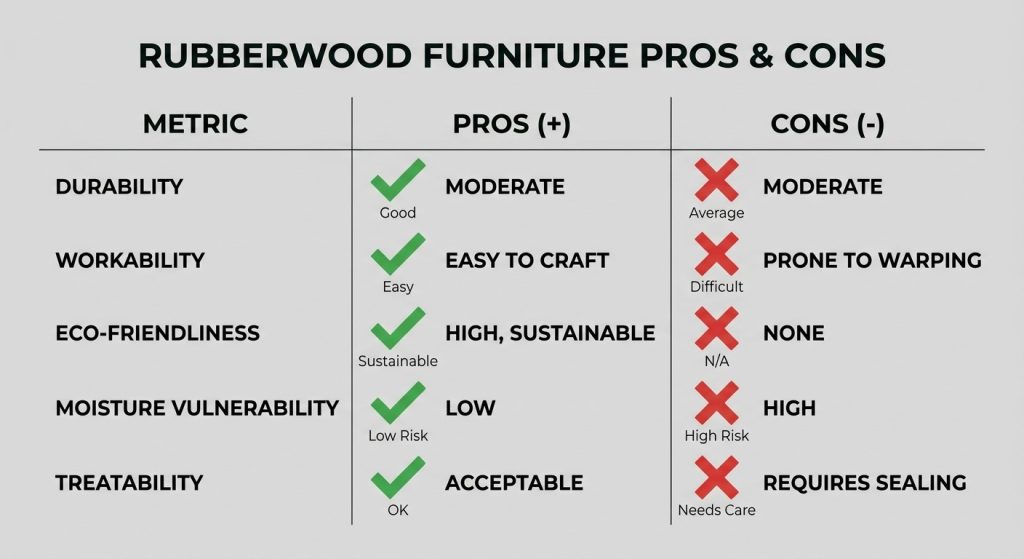
Rubberwood has practical advantages, but it also has limits that should not be ignored. For anyone asking “what is rubberwood”, the useful answer is not simply “good” or “bad.” It is a real hardwood with a light look, workable structure, and resource-efficient origin, but it needs the right use environment, finish, and product design.
1. Main Advantages of Rubberwood
Rubberwood is valued because it can offer a real wood feel without the higher cost or stronger grain character of some premium hardwoods. It is also easy to machine and finish, which makes it useful for many indoor products.
Its main advantages are easy to separate:
- Real wood feel
- Light appearance
- Workable grain
- Flexible finishing
- Resource-efficient source
2. Main Limitations of Rubberwood
Rubberwood is not naturally the best choice for wet, outdoor, or heavy-abuse environments. It can dent, absorb moisture, or show finish problems if the product design, treatment, or use conditions do not match the material.
The table below gives a balanced view of the main strengths and limits:
| Point | Advantage or Limit | Reader Judgment |
|---|---|---|
| Real hardwood | Advantage | Good for indoor products |
| Light color | Advantage | Easy to match finishes |
| Moderate hardness | Both | Confirm use intensity |
| Moisture sensitivity | Limit | Avoid damp exposure |
| Finish dependence | Limit | Check coating quality |
Key Takeaway: Rubberwood is practical and resource-efficient, but it performs best in dry indoor use.
VIII. How Does Rubberwood Compare with MDF, Plywood, Oak, and Maple?
Rubberwood compares best as real wood with moderate hardness, a light appearance, and better natural fiber structure than MDF or particle board. When people ask “what is rubberwood”, comparison helps because the name alone does not explain where it sits between engineered boards and harder premium woods. It is usually more practical than luxury and stronger than many low-grade board alternatives.
1. Rubberwood vs MDF and Plywood
Rubberwood is natural wood, while MDF is an engineered board made from wood fibers and resin. Plywood is also engineered, but its layered veneer structure gives it different strengths, so the best choice depends on whether the product needs a solid wood feel, panel stability, screw holding, or cost control.
This quick comparison helps separate the main material choices:
- Rubberwood: real wood
- MDF: smooth board
- Plywood: layered panel
- Oak: harder wood
- Maple: stronger surface
For a deeper board-material comparison, the particle board vs plywood guide explains how panel structure affects furniture strength, moisture risk, and screw holding.
2. Rubberwood vs Oak and Maple
Oak and maple are usually chosen when a stronger grain character, higher hardness, or more premium positioning matters. Rubberwood is often chosen when a lighter look, workable structure, and controlled cost are more important than a bold wood pattern or maximum surface hardness.
The table below keeps the comparison focused on practical material judgment:
| Material | Main Strength | Main Limit | Best Judgment |
|---|---|---|---|
| Rubberwood | Real wood feel with light color | Not the hardest wood | Good for indoor value |
| MDF | Smooth and flat surface | Not solid wood | Good for low-load panels |
| Plywood | Layered strength and stability | Different from solid wood feel | Good for structural panels |
| Oak | Strong grain and harder surface | Higher cost and heavier look | Good for premium pieces |
| Maple | Smooth and hard surface | Less flexible on cost | Good for heavy-use surfaces |
Key Takeaway: Rubberwood sits between engineered boards and premium hardwoods: real, practical, but not the hardest.
IX. Can Rubberwood Be Stained, Finished, and Used Long Term?
Rubberwood can be stained and finished well, but the final result depends on sanding, sealing, coating choice, and the environment where the product is used. When people ask “what is rubberwood”, they often want to know whether its light color is an advantage or a risk. The answer is that rubberwood can look clean and consistent, but finish approval matters.
1. Can Rubberwood Be Stained?
Rubberwood can take stain, paint, and clear finishes, but its light surface may show uneven absorption if preparation is not controlled. A good finish should be judged by color consistency, surface smoothness, edge coverage, and whether the approved sample can be repeated in later production.
A finished sample should make these details clear:
- Color tone
- Grain visibility
- Surface feel
- Edge coverage
- Repeatability
2. How Long Does Rubberwood Last?
Rubberwood can last well in dry indoor conditions when the product is properly dried, finished, and used within its material limits. It is a higher-risk choice for outdoor or damp environments, so long-term use depends more on the environment, coating protection, and product design than on the wood name alone.
For a deeper look at how coating choices affect wood protection, this outdoor wood finish guide explains why exposure level, surface preparation, and finish type should be judged together.
The table below shows when rubberwood is more likely to perform well over time:
| Use Condition | Finish Concern | Reader Judgment |
|---|---|---|
| Dry indoor room | Normal surface wear | Good fit |
| Dining or daily-use area | Dents and cleaning marks | Needs finish check |
| Damp room | Moisture absorption | Higher risk |
| Outdoor exposure | Weak rot resistance | Avoid in most cases |
| Repeat production | Color and surface variation | Keep approved sample |
Key Takeaway: Rubberwood can finish well and last indoors when moisture, coating, and use conditions are controlled.
X. Is Rubberwood Good for Furniture?
Rubberwood is good for furniture when the product is designed for dry indoor use, moderate daily wear, and a clean wood appearance. For readers asking “what is rubberwood”, this final judgment matters because the material name alone cannot prove quality. A well-made rubberwood piece can be practical, but the structure, finish, and use environment must match the product.
1. When Rubberwood Is a Good Furniture Material
Rubberwood works well for many indoor furniture pieces, including dining sets, shelves, cabinets, bed parts, and children’s furniture. It is especially suitable when the product needs a real wood feel, a light surface, and a finish that can match different room styles.
Rubberwood is usually a stronger choice when the project needs:
- Indoor placement
- Clean wood tone
- Real wood feel
- Controlled cost
- Repeatable finish
2. When Rubberwood Is Not the Best Choice
Rubberwood is not the best choice for outdoor furniture, wet rooms, or products that will face constant heavy impact. In those cases, the risk is not that rubberwood is a poor material, but that the material may not match the use condition.
Readers who want a more focused risk review can compare this material judgment with the detailed rubberwood furniture disadvantages guide before choosing a final product direction.
3. How to Judge Rubberwood Furniture Before Choosing It
The safest way to judge rubberwood furniture is to look beyond the wood name and confirm how the product is built and finished. For buyers comparing indoor wood options, EverWoody’s residential furniture range can also help show where material choice, structure, and finish need to work together.
The table below keeps the final buying judgment practical:
| Judgment Point | Better Condition | Higher-Risk Condition |
|---|---|---|
| Use environment | Dry indoor room | Outdoor or damp space |
| Product structure | Stable joints and panels | Unclear construction |
| Surface finish | Smooth, sealed, repeatable | Uneven or weak coating |
| Material description | Clear solid wood or panel details | Vague wood wording |
| Final choice | Matches use and design | Chosen by wood name only |
Key Takeaway: Rubberwood is a good furniture material when the design, finish, and use environment fit its limits.
FAQ
Can I use rubberwood for outdoor furniture?
Usually no. Rubberwood is better suited to dry indoor use because moisture exposure can increase the risk of swelling, finish problems, and long-term movement. Outdoor projects usually need wood or treatments designed for weather exposure.
What’s the best use for rubberwood?
Rubberwood works best in indoor furniture and household products where the surface can stay dry and the finish can be protected. It is especially practical for pieces that need a light wood look, a smooth finish, and a real wood feel.
How do I know if rubberwood is solid wood?
Check the product description carefully. Solid rubberwood may use solid pieces or joined rubberwood boards, while veneer, MDF, plywood, and particle board describe different structures. The clearest answer usually comes from the material specification, not the product photo alone.
Can rubberwood furniture last for years?
Yes, it can last well indoors when the product is properly dried, sealed, built, and used in suitable conditions. Long-term performance depends on structure, surface finish, humidity exposure, and how the furniture is used.
Is rubberwood better than MDF?
For real wood feel, screw holding, and repair potential, rubberwood is usually stronger than MDF. MDF can still be useful for flat panels or painted surfaces, but it is not the same as solid wood.
Closing note
This article explained what rubberwood is, how it performs, and when it fits for furniture use. If your project needs clearer material, finish, or product direction, EverWoody can help you review practical options through wood furniture sourcing support without replacing your final judgment.