
Buyers often assume all “PE rattan” performs the same. That assumption leads to fading, cracking, and disputes after delivery.
PE rattan is designed for outdoor use, but performance depends on material grade, formulation, and production control. The name alone does not guarantee durability.
Before comparing prices, you need to judge whether a supplier is using real outdoor-grade material or a lower-cost substitute.
PE rattan is a synthetic material used in outdoor furniture, but the name alone does not guarantee durability. The key difference lies in material quality, additives, and testing. To avoid failure, buyers must verify material definition, check for hidden substitutions, and confirm real performance under outdoor conditions.
Here’s where orders often go wrong:
- No clear material specs behind “PE rattan”
- Recycled or mixed material not disclosed
- UV resistance cannot be judged by appearance
- Samples do not reflect long-term performance
Most failures appear months later.
So the real question is not what PE rattan is.
It’s whether you can identify material risk before placing an order.
Keep reading — the next section shows where quality differences begin.
I. What Is PE Rattan Material and What Does It Really Tell You?
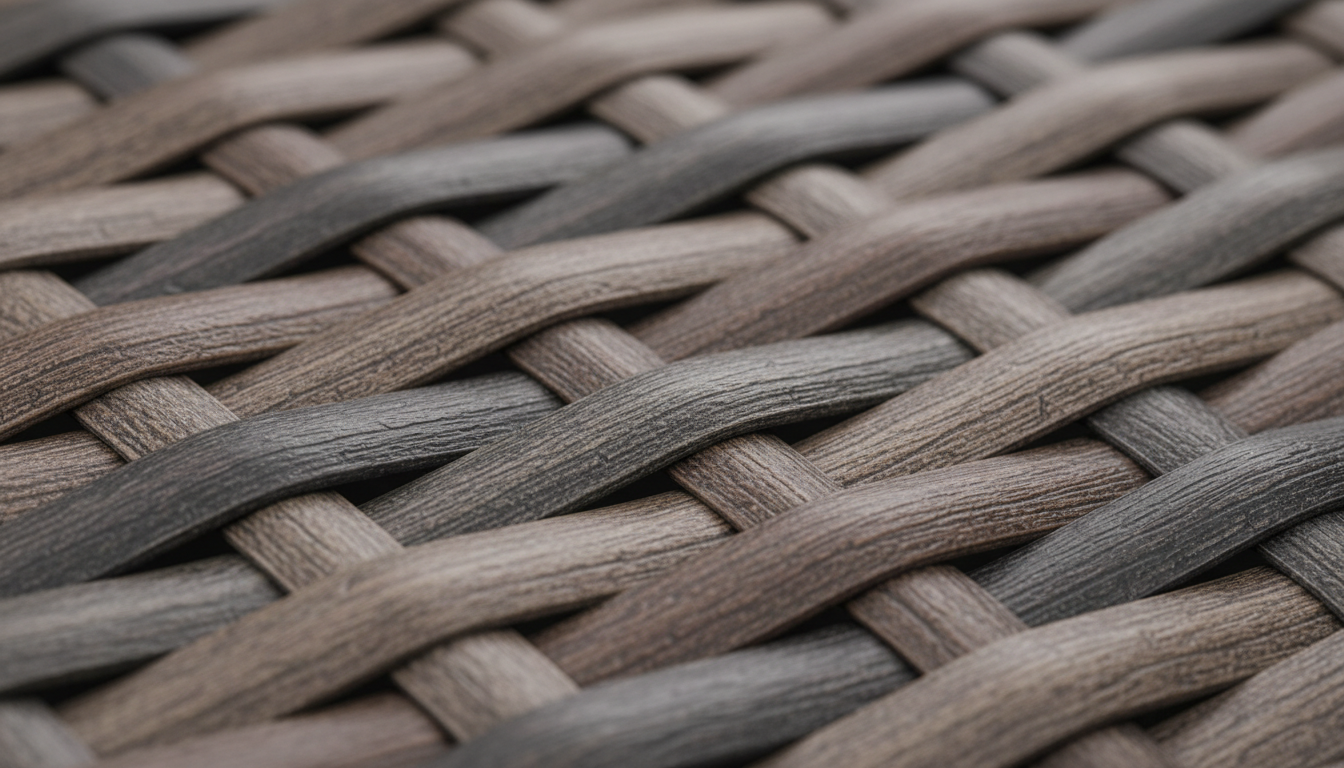
PE rattan refers to polyethylene-based synthetic wicker used in outdoor furniture, but the term itself does not define quality. The same label can be used for materials with very different durability, depending on resin grade, additives, and production control.
In other words, the name “PE rattan” does not guarantee performance.
How Do You Verify What “PE Rattan” Actually Means?
In real sourcing situations, “PE rattan” is often used as a general label rather than a controlled material specification. Two suppliers may use the same term while working with very different material compositions.
You should not rely on the name itself. Instead, you need to confirm what is behind it:
- The base material type (virgin HDPE or mixed/recycled PE)
- Whether UV stabilizers are included and how they are controlled
- Any available test results related to weather resistance
- Whether bulk production uses the same material as the sample
If these points cannot be clearly answered, the material is effectively undefined from a purchasing perspective.
Key Takeaway: “PE rattan” is only a category name. What matters is whether the supplier can clearly define and control the material behind it before production begins.
II. PE Rattan or Natural Rattan: Which One Actually Fits Your Use Case?

PE rattan and natural rattan are not interchangeable materials. One is engineered for outdoor exposure, while the other breaks down under moisture and sunlight. The real decision is not about appearance, but whether the material can survive your actual usage conditions.
If the usage scenario is unclear, the material decision is already at risk.
How Do You Decide Based on Real Usage Conditions?
Before comparing options, you need to map the real environment the product will face.
You can quickly assess this by checking:
- Will the furniture stay outdoors year-round
- Will it be exposed to direct sunlight for long periods
- Will it face rain, humidity, or temperature changes
- Whether maintenance and replacement are acceptable
If your answers point to continuous outdoor exposure, natural rattan is no longer a safe choice, even if it looks similar at the beginning.
Here’s what matters — short-term appearance often hides long-term failure.
What Happens If the Wrong Material Is Used?
This is where many buyers get caught.
Natural rattan may look fine at delivery, but once exposed to outdoor conditions, the degradation process starts. The issue is not immediate, which makes it harder to trace back to the supplier decision.
Typical outcomes include loss of structural integrity, surface cracking, and accelerated aging under sunlight and moisture.
This is exactly why material selection cannot be based on visual similarity.
How Should You Evaluate Supplier Recommendations?
Before deciding, it helps to simplify the comparison into clear decision signals:
| Scenario | Recommended Material | Risk Level | What It Means for You |
|---|---|---|---|
| Full outdoor exposure | PE rattan | Low | Stable performance over time |
| Partial outdoor (covered areas) | PE rattan | Medium | Still requires UV resistance |
| Indoor or decorative use | Natural rattan | Low | No exposure risk |
| Outdoor use with natural rattan | Natural rattan | High | High chance of early failure |
This comparison removes most of the confusion — once exposure conditions are clear, the material choice becomes straightforward.
Now think about this — if a supplier recommends natural rattan for outdoor use without clearly limiting the conditions, what are they optimizing for?
When Should You Question a Supplier’s Recommendation?
This is where you shift from comparing products to evaluating the supplier.
If a supplier suggests natural rattan for outdoor use without clearly defining exposure limits, the recommendation is likely based on cost or appearance rather than performance.
That creates a predictable outcome: the product looks acceptable at first, then starts degrading once it faces real conditions.
Key Takeaway: The material decision should follow exposure conditions, not visual preference. If a supplier cannot clearly explain where natural rattan will fail, the recommendation itself is already a risk signal.
III. PE Rattan vs PVC: What Are You Actually Comparing?
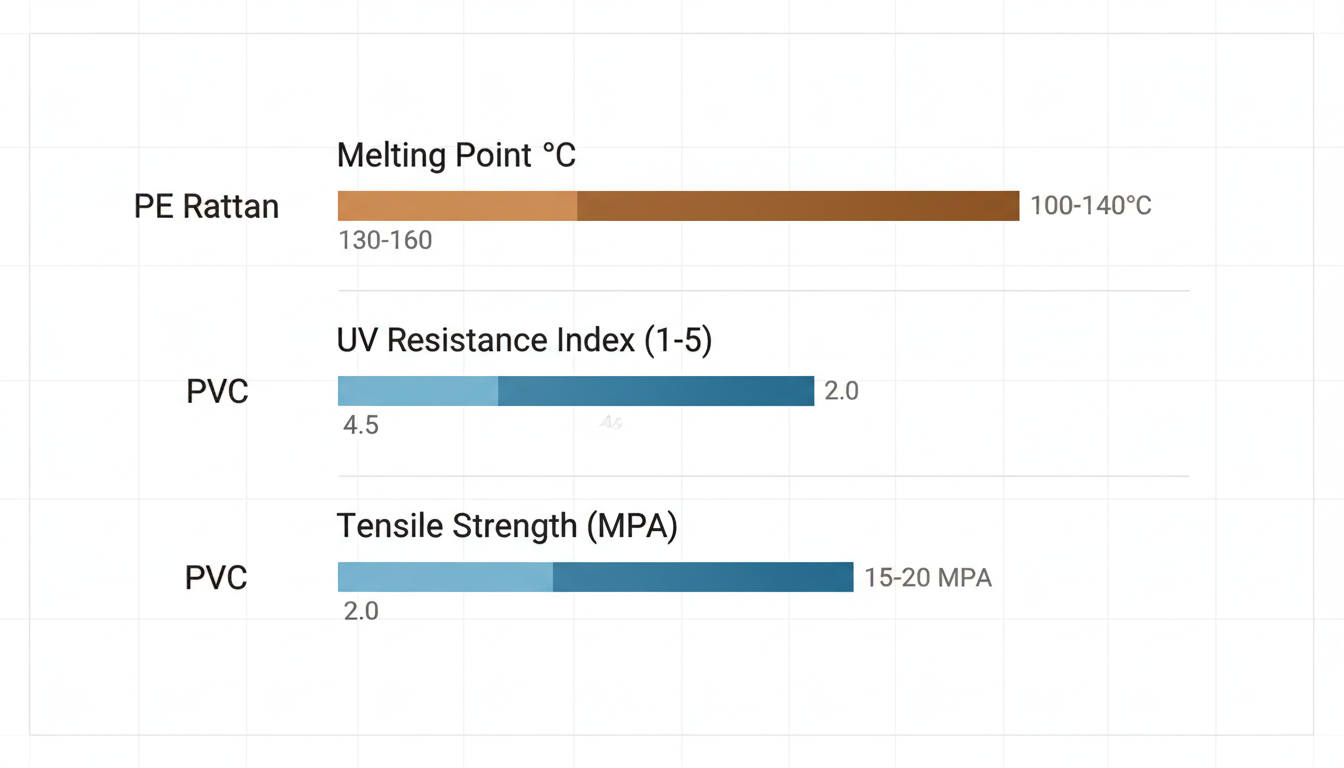
PE and PVC are both used in synthetic wicker, but they are not equivalent in outdoor performance. The key issue is not material type alone, but whether substitution or mixing happens without clear disclosure.
If the material is not explicitly defined, you are not comparing two options — you are comparing unknowns.
Why PVC Is Often Used as a Substitute
PVC is widely used to reduce cost, especially in price-driven projects. At the sample stage, it can look similar to PE and pass basic visual checks.
The difference starts to matter only after exposure to sunlight, temperature changes, and repeated use. That gap is where most problems begin.
So when a price looks unusually competitive, it is often tied to what sits behind the material label.
How Do You Check If the Material Is Clearly Defined?
This is where you take control of the decision.
Instead of focusing on appearance, you need to test how clearly the supplier defines the material. A simple way to do that is to ask direct questions:
- Is the material explicitly defined as PE, or only described as “rattan”
- If PE is claimed, whether PVC or mixed material is also used
- Whether the supplier can explain the performance difference between PE and PVC
- Whether any test data is available to support outdoor use claims
If these questions cannot be answered clearly, the material is not being controlled in a reliable way.
Now you start to see the pattern — unclear answers usually point to hidden substitution.
To make this easier to evaluate, compare what each situation actually means:
| Situation | What It Tells You | Risk Level |
|---|---|---|
| Clearly defined as PE with explanation | Material is likely controlled | Lower |
| Described only as “rattan” | Material is not clearly specified | Medium |
| PE mentioned but PVC not clarified | Possible mixing or substitution | High |
| Answers are vague or inconsistent | No material control in place | Very High |
This is where the decision becomes practical — you are not judging material theory, you are judging how much uncertainty you are accepting.
Why You Won’t See the Difference During Sampling
At the sampling stage, both PE and PVC can appear acceptable. Visual inspection does not reveal how the material will behave over time.
The difference shows up under real conditions: prolonged sunlight, temperature shifts, and repeated stress. That is why products that look fine at delivery can start to fail months later.
And this is exactly where many buyers get caught off guard.
Key Takeaway: If the supplier cannot clearly define and support the material behind “rattan”, you are not evaluating quality — you are accepting substitution risk that will only show up after delivery.
IV. Why Is PE Rattan Used for Outdoor Furniture — and Why That Still Doesn’t Guarantee Quality?
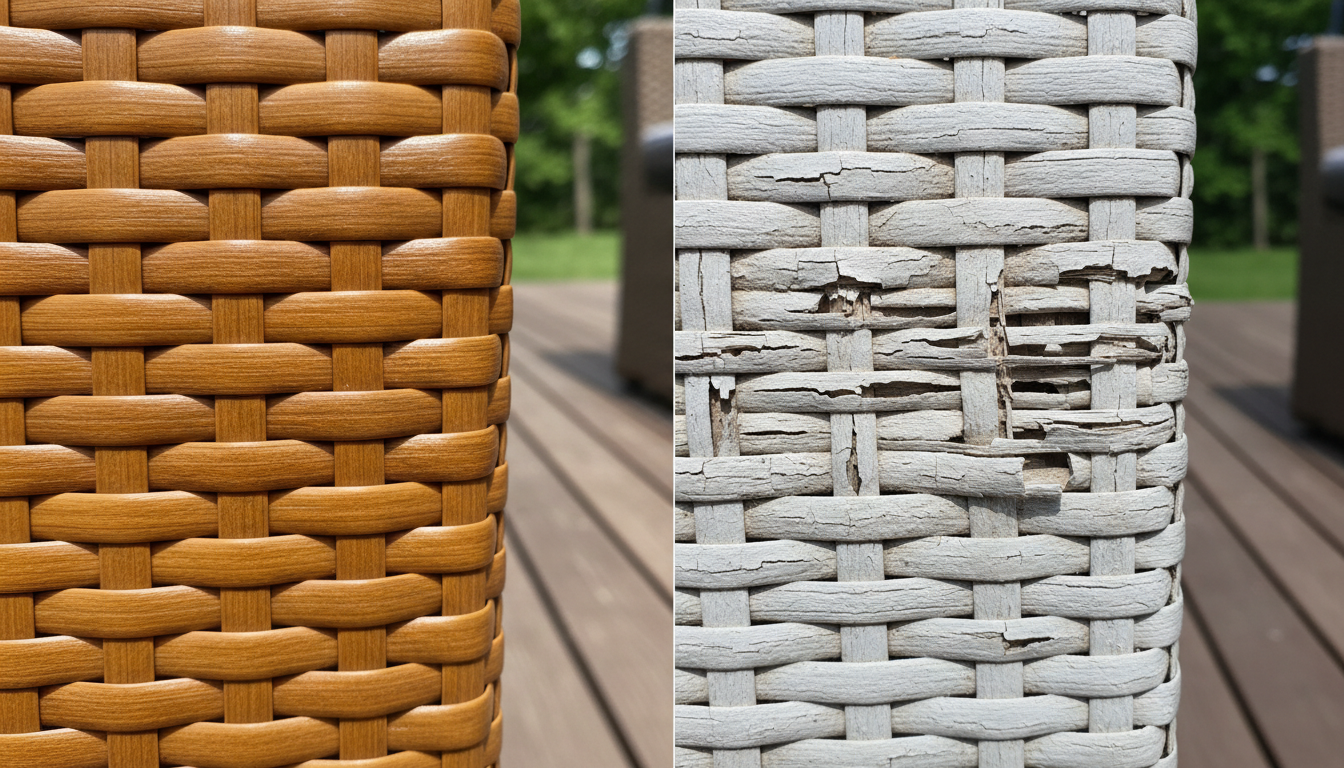
PE rattan is commonly used for outdoor furniture because it handles moisture, sunlight, and temperature changes better than natural rattan. However, this only explains why the material is chosen — it does not confirm whether it is produced at a level that can actually deliver long-term performance.
This is where many decisions go off track.
Does Outdoor Suitability Automatically Mean Reliability?
Not really.
A product can be labeled as “outdoor use” and still fail early if the material or production is not properly controlled. This is especially common when the focus is on initial appearance rather than long-term behavior.
Before accepting any “outdoor-grade” claim, you should pause and check what is actually being verified.
A quick way to do that is to look for:
- Whether the supplier can explain how the material handles UV exposure over time
- Whether there is any consistency control for temperature-related expansion or brittleness
- Whether performance is based on testing or only described in general terms
- Whether previous outdoor use cases are clearly defined or just assumed
If these points are unclear, the “outdoor” label is only a surface-level description.
Here’s where it becomes practical — the label explains intention, not performance.
To clarify what you are really dealing with, compare the claim with what is actually supported:
| Claim Type | What It Usually Means | Reliability |
|---|---|---|
| “Outdoor use” without detail | General positioning only | Low |
| Basic description (sun/rain resistant) | Concept-level understanding | Medium |
| Explanation with controlled factors | Some process awareness | Medium-High |
| Backed by testing or defined conditions | Performance is being verified | High |
This is the point where you stop accepting labels and start evaluating proof.
So even if a product is described as suitable for outdoor use, the real question is whether that suitability has been demonstrated or just assumed.
When Should You Treat “Outdoor Use” as a Risk Signal?
This depends on how the claim is presented.
If outdoor suitability is used as a selling point but cannot be supported with clear explanation or data, it often indicates that performance is not being managed at a detailed level.
That creates a predictable pattern: the product performs well initially, then starts to degrade under real conditions.
And that shift usually happens after the point where corrections are still easy.
Key Takeaway: “Outdoor use” explains why PE rattan is selected, but it does not confirm how well it is executed. If the claim is not backed by clear verification, it should be treated as a potential risk rather than a guarantee.
V. What Are the Common Problems With PE Rattan — and When Do They Actually Start?
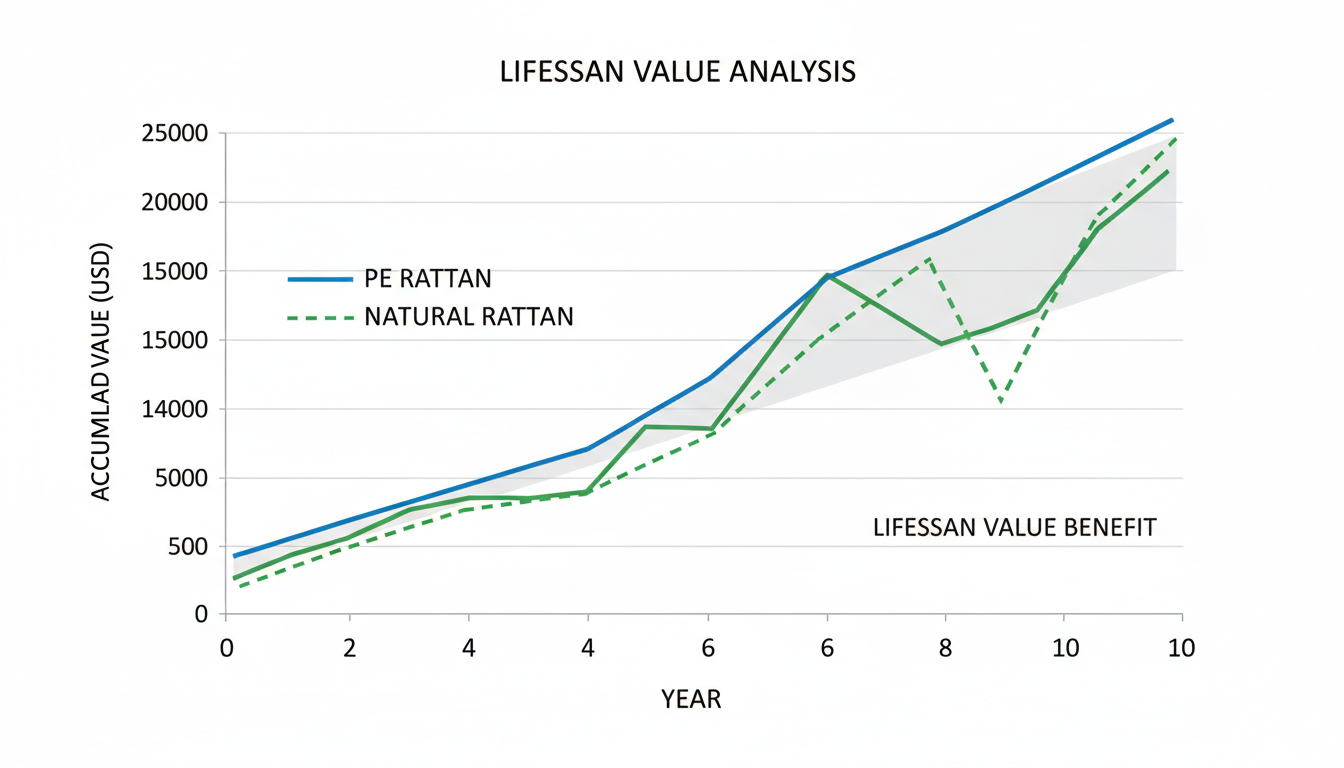
PE rattan failures rarely show up during inspection. Most problems appear after exposure to sunlight, temperature changes, and repeated use. The key issue is not what goes wrong, but when it becomes visible — often after delivery.
This means you are not just evaluating a product, you are evaluating how much delayed risk you are taking on.
What Does Fading or Color Change Really Indicate?
Color change is usually the first visible signal.
When fading or inconsistency appears, it often points to insufficient UV stabilizers or uneven material composition. These issues do not affect the initial look, but they quickly show under outdoor conditions.
From a purchasing perspective, this is not just a cosmetic issue — it directly affects perceived quality and customer acceptance, which is exactly why material consistency has to be checked as part of a real furniture quality control process.
And once color variation becomes visible, it is already too late to correct.
Why Cracking and Brittleness Matter More Than They Seem
Surface damage is where material weakness becomes structural.
Cracking or brittleness usually indicates that the material cannot handle repeated stress, temperature shifts, or long-term exposure. This often leads to breakage during normal use, not just extreme conditions.
At that point, the issue is no longer about appearance — it becomes a functional failure.
This is where supplier quality differences become impossible to ignore.
Why You Can’t Rely on Samples to Catch These Problems
This is the part most buyers underestimate.
At the sample stage, PE rattan can look flexible, consistent, and well-finished. However, these observations only reflect short-term conditions, not long-term behavior.
To reduce this blind spot, you need to actively check beyond appearance:
- Whether the material has been tested under UV exposure conditions
- Whether flexibility remains stable after temperature changes
- Whether any post-test inspection data is available
- Whether the supplier can explain how aging affects the material
If these checks are missing, the sample only confirms initial appearance, not durability.
Here’s where the real risk sits — what you see at sampling is not what you get after months of use.
To connect these failure patterns with what you can verify before ordering:
| Failure Pattern | What It Usually Means | When It Appears | What You Can Check |
|---|---|---|---|
| Fading / color inconsistency | Weak or uneven UV protection | After sun exposure | UV-related test or material explanation |
| Cracking / brittleness | Low material stability under stress | After repeated use | Flexibility under temperature variation |
| No issue during sampling | Only short-term condition observed | Before delivery | Presence of aging or durability testing |
This is where your evaluation shifts from “looks fine” to “will it still hold after use”.
So instead of asking whether the sample looks good, the better question is whether the material has been proven to last.
When Should You Treat These Risks as a Deal Breaker?
The timing is critical.
If these risks can only be discussed in general terms, or if the supplier cannot connect them to specific material control or testing, the outcome is already predictable.
That means the product may pass inspection but fail in real use.
And by the time that happens, the cost of correction is significantly higher.
Key Takeaway: Most PE rattan problems do not show up during inspection. If durability is not verified before ordering, you are accepting failure that will only appear after delivery.
VI. How Can You Tell If PE Rattan Is Good Quality Before It Fails?
PE rattan quality cannot be judged by appearance alone. Products that look smooth, consistent, and well-finished can still fail after exposure to sunlight, temperature changes, and repeated use.
The real question is not whether it looks good now, but whether it will remain stable over time.
What Should You Actually Check Instead of Appearance?
Visual consistency is often misleading.
A product can have uniform color and clean weaving, yet still use unstable material or insufficient additives. That is why surface inspection alone cannot confirm durability.
You need to shift your focus from how it looks to how it behaves under stress.
How Do You Test Flexibility and Stability in Practice?
This is where you move from observation to action.
Instead of accepting general statements like “flexible” or “durable”, you should verify how the material reacts under real conditions.
A practical way to do this is to check:
- Whether the material maintains flexibility after repeated bending
- Whether it shows whitening, cracking, or stress marks under pressure
- Whether flexibility changes after exposure to heat or sunlight
- Whether the supplier can demonstrate consistency across different batches
If these checks cannot be performed or explained, only flexibility is assumed, not verified.
Now you start to see the difference — stable material behaves consistently, unstable material only looks acceptable at first.
What Do These Signals Actually Mean for Your Decision?
Once you move beyond appearance, the evaluation becomes much clearer.
Different signals point to very different levels of risk, even if the product initially looks acceptable.
To make this easier to judge, compare what each signal actually indicates:
| Observation | What It Suggests | Risk Level |
|---|---|---|
| Remains flexible under repeated stress | Material stability is controlled | Low |
| Slight stiffness under pressure | Potential formulation issue | Medium |
| Whitening or stress marks appear | Early-stage material fatigue | High |
| Cracking or surface breakage | Structural instability | Very High |
This is where visual quality stops being useful, and material behavior becomes the real indicator.
Key Takeaway: Good PE rattan is not defined by how it looks, but by how it behaves under stress and over time. If performance cannot be demonstrated beyond appearance, the risk remains hidden until after delivery.
VII. How Is PE Rattan Made and Tested — and What Should You Ask for Proof?
PE rattan performance is determined by formulation, processing, and testing — not by how the product looks. These factors are not visible at the product stage, which is why quality differences only appear after use.
If testing and verification cannot be clearly demonstrated, the material should be treated as unproven.
Why Production and Formulation Alone Are Not Enough
Suppliers often explain how the material is made, but production details do not guarantee performance.
Even with similar processes, differences in raw material quality and additive control can lead to very different outcomes in outdoor conditions.
This is where many evaluations go wrong — understanding the process is not the same as verifying the result, and it is also one of the reasons furniture orders fail after a sample looks acceptable.
What Happens If Testing Cannot Be Clearly Proven?
This is your decision point.
Instead of asking what tests exist, you should evaluate whether they can be clearly explained and connected to real use conditions.
If not, treat the material as unverified:
- If UV testing cannot be explained → treat it as not tested
- If no temperature or stress testing is mentioned → assume stability is not controlled
- If results are described vaguely → treat them as non-existent
- If testing cannot be linked to real outdoor use → treat it as irrelevant
If these conditions apply, you are not evaluating performance — you are accepting uncertainty.
Now the situation becomes clear — what cannot be verified should not be trusted.
How Should You Interpret Supplier Responses Before You Decide?
Once you receive answers, the decision is no longer technical — it becomes binary.
Either the material is supported by clear verification, or it is not.
To simplify this, you can interpret responses like this:
| Supplier Response | What It Means | Decision |
|---|---|---|
| No testing provided or explained | No verification exists | Stop |
| Vague or general statements | No reliable control | Pause |
| Basic testing mentioned without detail | Partial control | Review carefully |
| Clear testing with explanation and relevance | Performance is verified | Continue |
This is where you stop comparing claims and start making decisions.
And this is where weak suppliers can no longer hide behind general descriptions.
Key Takeaway: Testing is not an added benefit — it is the minimum requirement. If performance cannot be clearly verified before ordering, the safest decision is to stop.
VIII. When Should You Choose PE Rattan — and When Should You Walk Away?

PE rattan is widely used for outdoor furniture, but choosing it is not a decision about material alone. It is a decision about whether the material, production, and verification behind it are reliable.
At this stage, the question is no longer what PE rattan is — it is whether this specific product is safe to proceed with.
When Does PE Rattan Actually Make Sense for Your Project?
PE rattan works well in outdoor furniture when durability is required, and the material is properly controlled.
But that only applies when the supplier can clearly define and verify how the material performs under real conditions.
Before moving forward, you should confirm:
- Whether the material is clearly defined (not just labeled as “rattan”)
- Whether substitution or mixing has been ruled out
- Whether testing can be explained and linked to real use
- Whether the sample performance is supported by durability verification
If these conditions are met, the material choice is no longer the main risk.
This is where the decision starts to become practical — you are no longer guessing, you are confirming.
When Should You Treat the Order as Too Risky to Continue?
This is the cutoff point.
If key information remains unclear, continuing the discussion only increases exposure to delayed problems.
You should pause or stop when:
- Material definition remains vague or inconsistent
- Testing cannot be clearly explained or verified
- Performance is described but not demonstrated
- Answers change depending on who you ask
If these signals appear, the risk is no longer theoretical.
Now it becomes a matter of timing — the earlier you stop, the lower the cost.
To make the decision clearer, align each situation with a direct action:
| Situation | What It Means | Action |
|---|---|---|
| Clear material + verified testing | Performance is controlled | Continue |
| Minor gaps but mostly defined | Some uncertainty remains | Review |
| Vague material or unclear answers | Risk is building | Pause |
| No verification or inconsistent responses | No control in place | Stop |
This is where you move from evaluation to decision.
And this is where hesitation usually creates the biggest losses.
Key Takeaway: Choosing PE rattan is not the real decision. The real decision is whether the supplier can remove uncertainty before production. If not, stopping early is often the safest option.
Frequently Asked Questions
Q1. Can PE rattan be used outdoors in winter?
It can handle low temperatures, but only if the material remains stable under temperature changes. Without proper formulation and testing, brittleness can still occur.
What matters is not whether it is labeled for outdoor use, but whether performance under real conditions has been verified.
Q2. Is PE rattan environmentally friendly?
This depends on the material composition.
Recycled content may reduce cost, but it can also reduce stability if not properly controlled. Without a clear material definition, environmental claims do not provide useful information for performance evaluation.
Q3. What are the signs of low-quality or unstable PE rattan?
Some early signals can appear even before long-term use, but they are often overlooked.
You can watch for:
- Noticeable plastic smell
- Uneven or inconsistent surface finish
- White stress marks when bent
- Reduced flexibility under light pressure
These signs do not guarantee failure, but they often indicate weak material control.
Closing Note
By now, you can already filter out unclear materials and weak supplier claims.
If you are evaluating a product right now, define three things first: material type, outdoor conditions, and expected order quantity.
With these in place, you can quickly check whether the product you are considering can actually meet your requirements before production begins.
If you want to see how this applies across different product categories and sourcing situations, you can start here.