We help importers and retailers get stable quality, clear updates, and worry-free shipments.
Design drawing in 48h, sample in 3–4 weeks
50–300 pcs flexible MOQ
FSC wood & water-based finishes optional
Request a Quick Quotation
We'll reply within 6 working hours
Is Rubberwood Good for Furniture? Pros, Cons, and Real Use Cases
March 24, 2026
Home→Blog→Is Rubberwood Good for Furniture? Pros, Cons, and Real Use Cases
Rubberwood is widely used in furniture manufacturing, but many buyers are unsure whether it is a reliable material choice.
Some sources highlight its affordability and sustainability, while others point out concerns about durability and moisture sensitivity. This makes it difficult to judge its real performance in actual use.
This article focuses on when rubberwood works well, when it does not, and how to evaluate it based on your product and sourcing needs.
I. Is rubberwood furniture good overall?
Rubberwood furniture can be a good choice for indoor use, especially when cost, consistency, and large-volume production matter. However, it is not suitable for outdoor use or high-moisture environments, where durability can become an issue.
In most cases, rubberwood works well for mid-range furniture that requires a stable supply and repeatable quality. It offers a practical balance between cost and performance, particularly for indoor applications.
The key is not whether rubberwood is “good” or “bad”, but whether it fits your product type, price positioning, and usage conditions.
II. When is rubberwood furniture a good choice?
Rubberwood furniture works well when cost efficiency, stable supply, and consistent production quality are more important than maximum hardness or long-term wear resistance.
It is commonly used in indoor furniture across mid-range price segments, where it offers a practical balance between performance, appearance, and cost.
1. Rubberwood is durable enough for daily indoor use
Rubberwood performs reliably in most indoor environments and is generally durable enough for routine household use when properly processed. In practical terms, it supports everyday activities such as dining, seating, and storage without major structural issues, as long as production standards are controlled.
Moisture control: Durability is closely tied to drying quality. Rubberwood is sensitive to moisture variation if it is not properly kiln-dried before manufacturing. When moisture content is inconsistent, the furniture may develop warping, cracking, or joint instability over time. These issues often appear after shipping or during seasonal humidity changes rather than immediately after production, which makes them harder to detect early.
Performance in daily use: Under stable indoor conditions, rubberwood handles repeated daily contact well. It maintains structural integrity in furniture such as dining tables, chairs, and cabinets where load conditions remain moderate. It is not a fragile material, but it is also not designed to tolerate misuse or extreme conditions.
Decision boundary: Choose rubberwood when the product will be used indoors with stable humidity and normal load conditions, and when the supplier can demonstrate consistent drying control. Avoid it if the production process is unclear or if the product may be exposed to fluctuating moisture or long-term dimensional stress.
2. Rubberwood performs reliably in frequent-use furniture
Rubberwood is suitable for furniture that experiences regular, repeated use, provided the load level remains within a moderate range. It performs consistently in residential and light-use environments where stress is predictable and controlled.
Performance in frequent-use settings: Rubberwood resists moderate surface compression and maintains shape under repeated use. In furniture such as dining chairs, tables, and storage units, it performs well over time when the design is structurally sound, and the usage remains within normal limits.
Load limitations: The material is not designed for heavy-duty or high-impact conditions. Continuous heavy pressure, strong impact, or long-term stress will gradually expose its limitations. Compared to denser hardwoods, it will show wear earlier under demanding conditions.
Typical use scenarios:
Dining furniture used multiple times daily in household settings
Bedroom furniture with stable weight distribution
Storage units with repeated but moderate load cycles
Decision boundary: Choose rubberwood when usage frequency is high, but load intensity is controlled. Avoid it in environments where furniture must withstand heavy pressure, rough handling, or intensive commercial use.
3. Rubberwood is mainly used in standard indoor furniture
Rubberwood is mainly used in standard indoor furniture categories where performance expectations are moderate, and production consistency is important. It is not positioned as a high-performance structural material, but as a practical solution for everyday furniture.
Common product categories: Rubberwood is widely used in beds, wardrobes, dining sets, cabinets, and shelving. These products typically operate in stable indoor environments with predictable usage patterns and moderate load requirements.
Production characteristics: Its relatively consistent structure allows for more predictable machining and finishing. This supports stable production output, especially in product lines that require uniform appearance and repeatable quality across batches.
Usage boundaries: Rubberwood is rarely suitable for outdoor furniture or for applications exposed to moisture variation. It is also not ideal for structural designs that depend on high load-bearing capacity over long periods.
Decision boundary: Choose rubberwood when the product belongs to standard indoor furniture categories with controlled use conditions. Avoid it when the design or positioning requires heavy-duty performance or exposure to environmental variation.
4. Rubberwood offers mid-range hardness compared to other woods
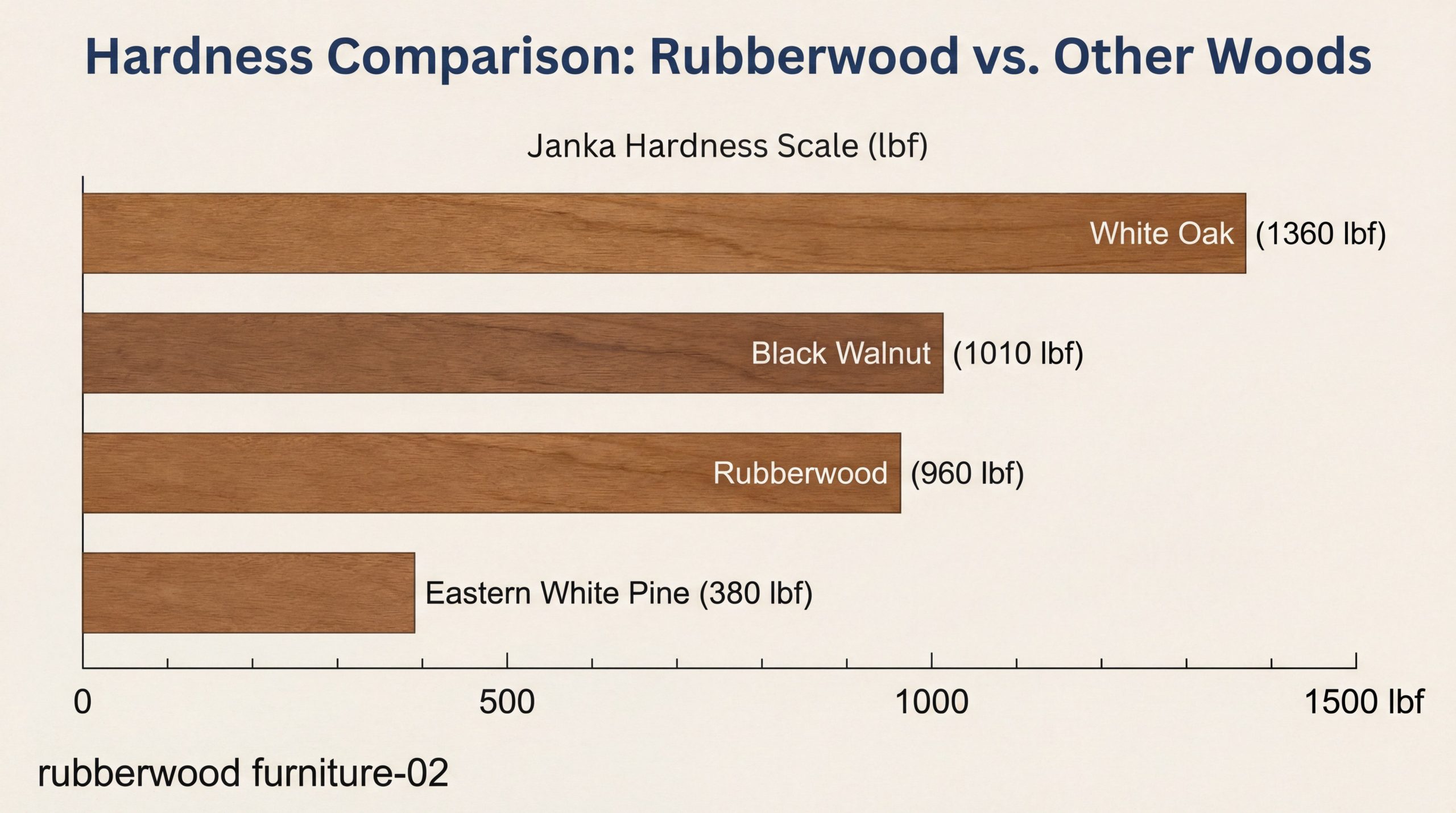
Rubberwood offers mid-range hardness compared to other woods, and that middle position explains both its advantages and its limitations. It is stronger than low-density softwoods but does not reach the durability level of denser hardwoods.
Hardness level: With a Janka hardness around 960 lbf, rubberwood sits between materials like pine and hardwoods such as oak. This gives it a noticeable improvement over softwood performance while remaining below high-density benchmarks.
What that means in practice: This level of hardness provides reasonable resistance to dents, surface wear, and everyday pressure in indoor furniture. It is suitable for tables, chairs, cabinets, and bed structures used in normal residential environments. However, it is not designed for long-term heavy stress or high-impact use.
Processing implications: Its moderate hardness makes it easier to machine and handle compared to denser hardwoods. This improves efficiency in production and reduces some manufacturing complexity, which is relevant in cost-controlled projects.
Decision boundary: Choose rubberwood when moderate durability is sufficient and processing efficiency matters. Avoid it when the product depends on high hardness, long-term wear resistance, or premium material positioning.
The following data explores the mechanical properties of rubberwood furniture compared to common market alternatives to help you assess its structural viability.
Wood Species
Janka Hardness (lbf)
Density (kg/m³)
Use Case Suitability
Rubberwood
960
560 – 640
High-traffic residential
White Oak
1,360
750 – 770
Luxury heirloom pieces
Eastern White Pine
380
350 – 400
Light-duty economy
5. Rubberwood provides a balanced cost-to-performance option
Rubberwood provides a balanced cost-to-performance option in projects where material efficiency, supply stability, and usable performance are more important than maximum strength. It is often selected as a practical compromise rather than a premium solution.
Cost efficiency: Rubberwood is generally more affordable than many hardwood alternatives, which makes it suitable for mid-range product lines where pricing is a key factor. It allows buyers to maintain acceptable performance without significantly increasing material cost.
Supply and production stability: It is commonly available for repeat production, which supports ongoing orders and consistent product lines. This reduces sourcing uncertainty compared to less widely available materials.
Processing and logistics advantages: Rubberwood is easier to machine and lighter to handle than many dense hardwoods. This helps improve production efficiency and can reduce transportation costs, especially in export scenarios.
Decision boundary: Choose rubberwood when the goal is to balance cost, supply stability, and acceptable performance in indoor furniture. Avoid it when the product requires premium positioning, long service life under heavy load, or maximum material strength.
6. Rubberwood fits mid-range furniture sourcing with strong value
Rubberwood is widely used in mid-range furniture sourcing because it offers a stable balance between cost and performance.
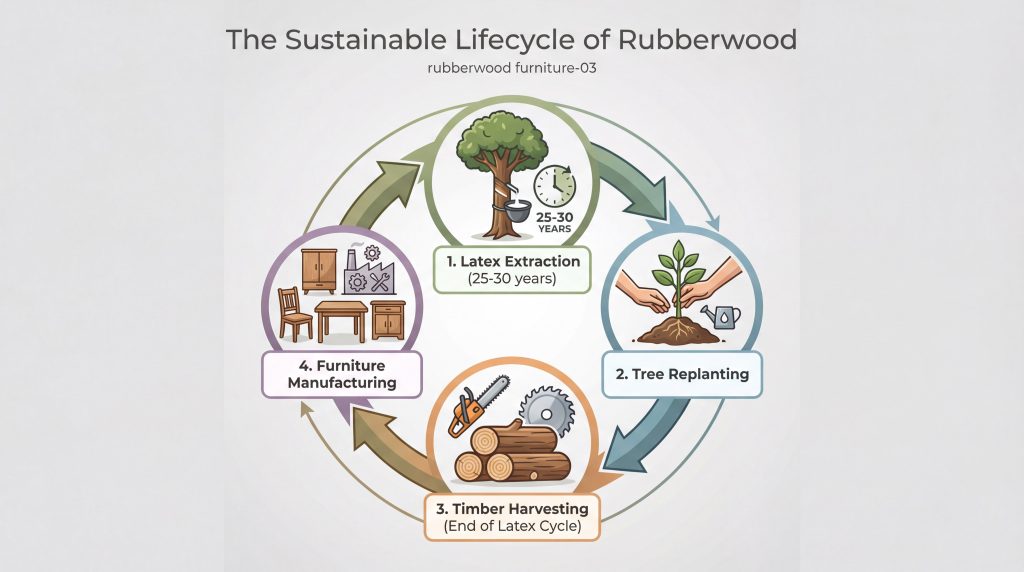
Unlike premium hardwoods such as oak or walnut, rubberwood pricing is not driven by scarcity. Its supply comes from the rubber industry, which keeps raw material costs more predictable in bulk orders.
For buyers, this means the budget can be allocated differently—not just on material, but on construction quality, hardware, and finishing. In many cases, the end product delivers a similar user experience in indoor environments, despite a lower material cost.
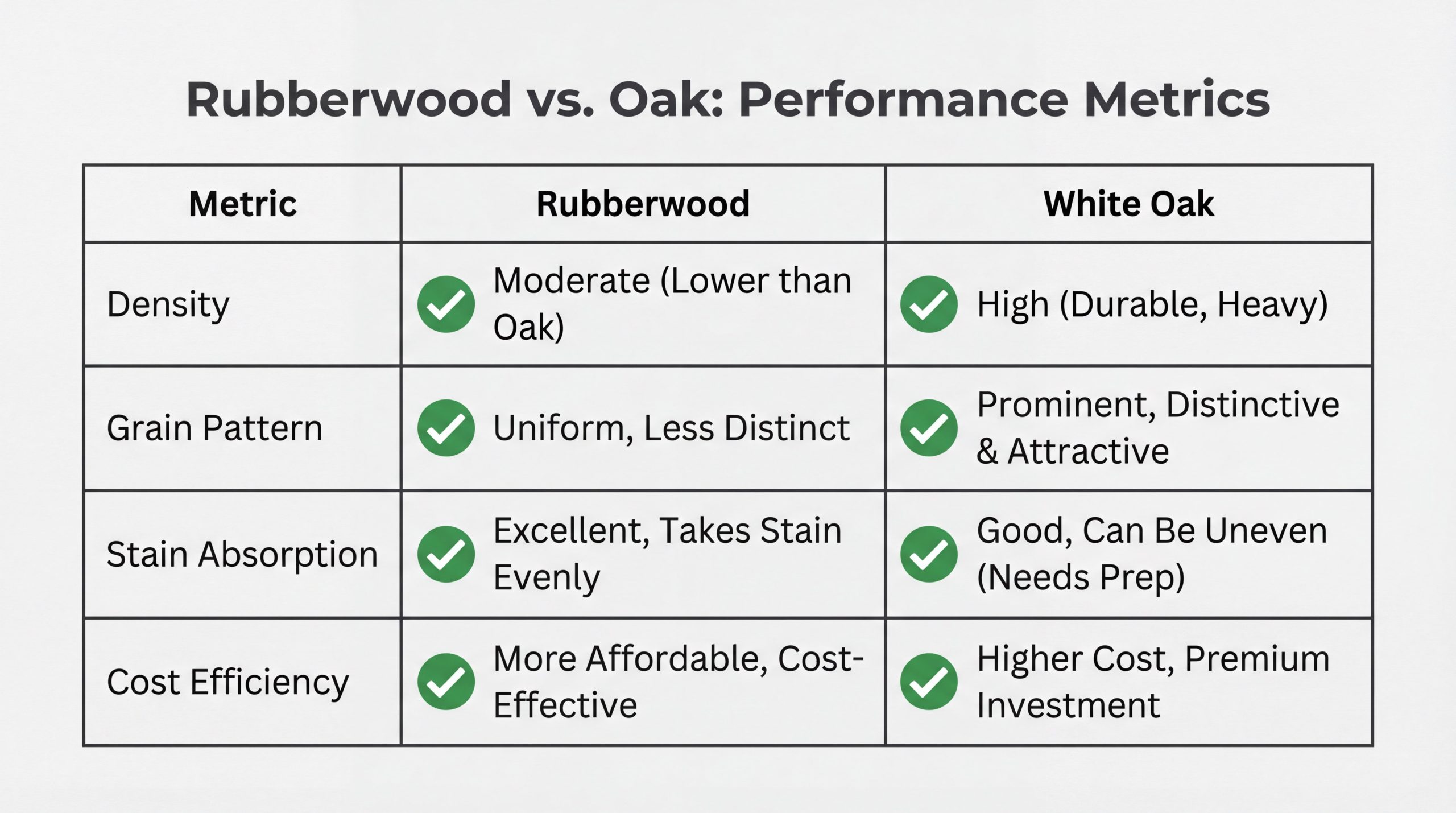
However, rubberwood is not suitable for all positioning. If your product relies on visible grain character, long lifespan expectations, or premium branding, upgrading to hardwoods becomes necessary.
The decision is not about which material is better, but whether the price segment and product expectation match.
Procurement comparison (6-piece dining set):
Factor
Solid Rubberwood
Solid White Oak
Estimated Cost
800–1,200 USD
2,500–4,000 USD
Longevity (Indoor)
20–30 Years
50+ Years
Value for Money
Very High
Moderate
Sustainability Impact
High Positive
Neutral
Key Takeaway: Rubberwood is a practical choice for standard indoor furniture when usage conditions are stable, supplier processing is reliable, and performance expectations stay within a mid-range range rather than a heavy-duty one.
III. When is rubberwood furniture NOT a good choice?
Rubberwood is not suitable for every application, especially when environmental conditions go beyond stable indoor use.
Its limitations become critical in moisture-heavy, outdoor, or poorly controlled environments, where long-term stability and durability are harder to maintain.
1. Rubberwood is not suitable for high-moisture or outdoor environments
Rubberwood lacks natural resistance to moisture, insects, and weather exposure, which makes it vulnerable in unstable environments.
In humid conditions, unsealed surfaces can absorb moisture quickly, leading to swelling, surface damage, or long-term deformation.
Outdoor use introduces additional risks such as decay and insect attack, especially when no specialized treatment is applied.
Even in semi-outdoor spaces like balconies or covered patios, performance may decline faster compared to materials designed for exterior use.
For sourcing decisions, this is not a minor limitation—it directly affects product lifespan and after-sales risk.
2. Rubberwood shows higher stability risks under fluctuating humidity
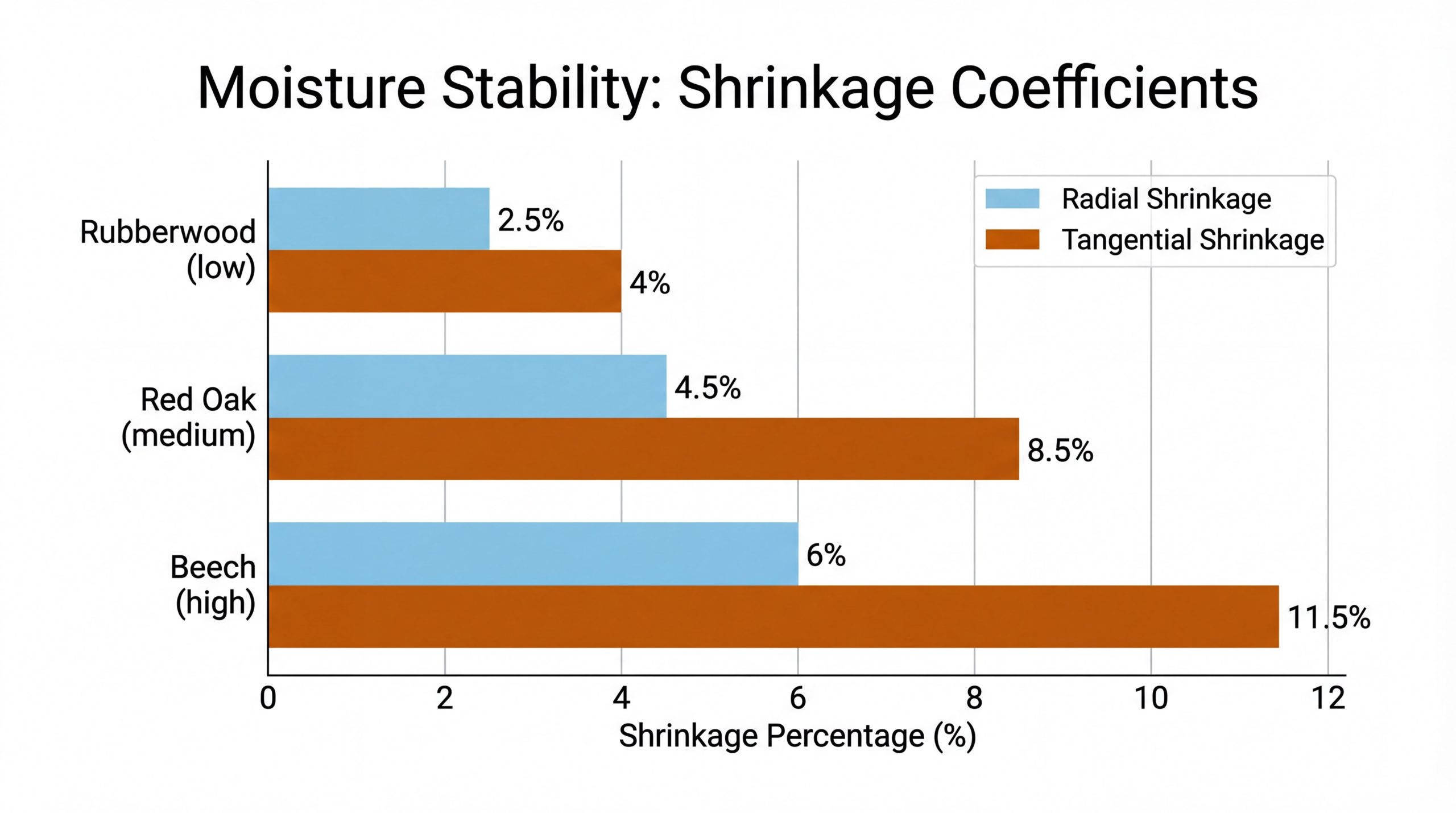
Dimensional stability depends heavily on moisture control during both production and use.
In environments where humidity changes frequently, rubberwood may expand and contract more noticeably, increasing the likelihood of warping, joint loosening, or surface cracking.
This risk becomes more visible in larger panels, long components, or poorly engineered structures.
Without proper kiln drying and sealing processes, these issues may appear within months rather than years.
For bulk buyers, this is less about material quality and more about whether processing standards are consistently controlled.
Environmental risk assessment for rubberwood furniture:
Environment Type
Risk Level
Main Issue
Recommendation
Dry indoor (stable AC)
Low
Minimal movement
Suitable
Normal indoor use
Medium-Low
Minor expansion
Acceptable
High humidity indoor
Medium-High
Swelling / warping
Use with sealing
Semi-outdoor (covered)
High
Faster degradation
Not recommended
Full outdoor exposure
Very High
Decay / insects
Avoid
Key takeaway: Rubberwood is not inherently weak, but its performance is highly dependent on environmental control. For outdoor applications, it is better to choose materials specifically designed for weather resistance.
is rubberwood good for furniture
IV. What limitations do buyers often overlook?
Rubberwood itself is not the main risk. The real issues often come from how it is processed and handled during production.
Many quality problems are not visible at the sample stage but appear later during use.
1. Buyers often assume sample quality reflects bulk performance
A clean sample does not guarantee stable mass production.
In many cases, samples are made from carefully selected pieces with better moisture control and finishing. Bulk production, however, depends on consistent processing across large volumes.
Differences in drying conditions, storage, or batch variation may not be visible during sampling but can appear later as:
warping
cracking
joint issues
This is why relying only on sample appearance often leads to incorrect expectations about long-term performance.
2. Buyers underestimate the impact of moisture control during production
Moisture content is one of the most critical but least visible factors in rubberwood furniture.
Even small deviations in kiln drying or storage conditions can lead to internal stress in the wood. These issues often do not appear immediately but become visible later, after shipping or seasonal changes.
Buyers focusing only on material type may overlook how processing quality directly affects stability.
In practice, moisture control often matters more than the wood species itself.
3. Buyers focus on material type but ignore structural design
Material choice alone does not determine durability.
Weak joinery, insufficient reinforcement, or poor assembly precision can significantly reduce load-bearing capacity and long-term stability.
Even high-quality rubberwood can perform poorly if the structure is not designed for repeated use.
For furniture used frequently—such as dining chairs or children’s furniture—construction quality often has a greater impact than material selection.
4. Buyers overlook how finishing affects durability and consistency
Surface treatment is not just about appearance.
Proper sealing reduces moisture absorption, while consistent coating improves wear resistance and color stability.
Inconsistent finishing may lead to visible defects such as:
uneven color
rough surfaces
early coating failure
In bulk orders, finishing consistency often determines whether products meet retail standards.
Common buyer assumptions vs actual risk in rubberwood furniture:
Buyer Assumption
Reality
Resulting Risk
Sample quality = bulk quality
Processing varies across batches
Inconsistent performance
Wood species determines durability
Processing and structure matter more
Misjudged product lifespan
Indoor use = no risk
Humidity still affects stability
Warping or cracking
Finishing is cosmetic only
It affects protection and durability
Surface defects, shorter lifespan
Key takeaway: Most sourcing problems with rubberwood are not caused by the material itself, but by how buyers evaluate it. Focusing only on wood type while ignoring processing, structure, and finishing often leads to incorrect decisions and avoidable quality issues.
V. How does rubberwood compare to other wood types?
Rubberwood is often compared with other commonly used furniture woods, especially when buyers are balancing cost, durability, and application. Understanding these differences helps determine whether rubberwood fits a specific product or market positioning.
1. Rubberwood differs in cost, hardness, and use
Rubberwood differs from other common furniture woods primarily in cost level, hardness, and typical applications, especially when compared across different material categories.
Wood Type
Hardness (Janka)
Cost Level
Stability
Typical Use
Rubberwood
~960 lbf
Low–Medium
Moderate
Indoor furniture, mass production
Oak
~1300 lbf
Medium–High
High
Premium furniture, load-bearing
Pine
~380 lbf
Low
Low
Lightweight furniture, low-cost items
In practical terms, rubberwood sits between softwood and hardwood in overall performance. It offers more stability than pine while remaining more affordable than oak, which makes it a common choice for mid-range furniture production.
2. Rubberwood offers balanced but not premium performance
Rubberwood delivers balanced overall performance, but it does not reach the strength and durability levels of premium hardwoods. Rubberwood tends to provide more predictable cost control and a more uniform grain structure, which makes finishing easier and more consistent in bulk manufacturing.
At the same time, it does not offer the same level of load-bearing capacity or long-term durability as denser hardwoods. This means that while it performs reliably in standard indoor furniture, it is not suitable for applications where high strength or long service life under stress is required.
3. Rubberwood fits indoor use, not high-stress conditions
Rubberwood is best suited for indoor, mid-range furniture, but it is not suitable for high-stress or heavy-duty applications.
Rubberwood is a better choice when:
The product is strictly for indoor use with controlled humidity
Cost consistency across bulk orders is a priority
The design relies on painted or uniform finishes rather than natural grain
Load conditions remain moderate and predictable
Hardwoods are a better choice when:
The furniture may face higher stress or variable conditions
The product requires a higher load-bearing capacity
Long-term durability is a key selling point
Visible grain and material perception affect pricing
However, it becomes less suitable when the product is positioned as premium, when visible grain character is important, or when the furniture needs to withstand higher structural stress. In these cases, hardwoods such as oak or maple are typically a better match.
For most sourcing decisions, the real question is not which wood is stronger, but which one matches the product’s price level and usage conditions.
Key Takeaway: Rubberwood fits mid-range, indoor furniture where cost control and consistency matter. Hardwood becomes necessary when durability, strength, or premium perception drive the product.
Frequently Asked Questions (FAQ)
Can I use rubberwood for heavy kitchen use? While it is excellent for dining tables and chairs, rubberwood is a “thirsty” wood that can be sensitive to standing water. It can be used for butcher blocks and carts if sealed meticulously with food-safe mineral oil, but it is not recommended for permanent countertop installations where frequent water contact is unavoidable.
What is the best finish for rubberwood? For factory-grade results, a clear lacquer or high-quality polyurethane is the best option for daily protection. These sealants highlight the uniform grain while providing a moisture barrier that compensates for the wood’s natural absorbency, ensuring the piece stays protected against spills.
How do I know if it is real rubberwood? Check for the signature “finger-joint” patterns on larger surfaces like tabletops, which appear as zig-zagging seams connecting smaller planks. If the wood feels significantly heavier and more “solid” than Pine, but features a light, uniform grain without the heavy “flecking” of Oak, it is likely solid rubberwood.
Final check
Rubberwood solves the conflict between budget and quality, offering a sustainable, industrial-grade hardwood that thrives in modern homes. As a leading supplier, we provide the technical expertise to ensure your timber is stable, safe, and beautiful. Build your future with durable materials and design-forward solutions from the Everwoody experts today.