
Struggling with fragmented supply chains often leads to unconfirmed gaps in your inventory arrival times. Without a robust furniture manufacturing process, your brand risks high replacement costs and a damaged reputation. This comprehensive guide provides the expert roadmap you need to master procurement.
The furniture manufacturing process is an intricate industrial workflow that transforms raw timber into finished goods through design, engineering, precision cutting, assembly, and finishing. This systematic approach ensures structural durability and aesthetic consistency for global importers seeking high-volume production with a focus on quality control and sustainable material sourcing.
I. What Is Furniture Manufacturing?
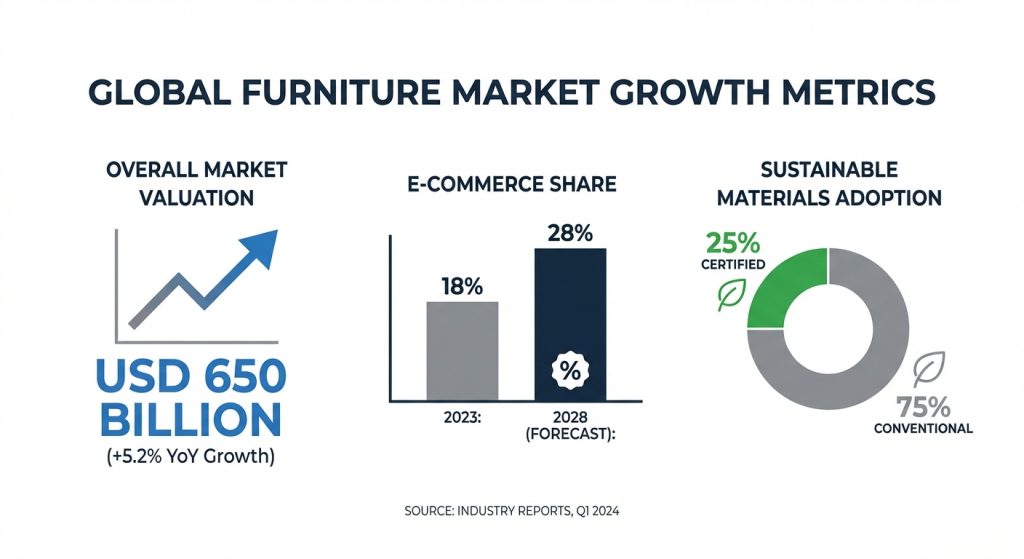
The furniture manufacturing process is a systematic industrial methodology used to transform raw timber and secondary components into functional, high-value interior assets. When you manage large-scale procurement, understanding this workflow allows you to predict lead times and identify potential grey zones before they impact your retail schedule. You must view this not as a simple assembly line, but as a sophisticated integration of craftsmanship and mechanical precision.
Defining the Core Workflow
You will find that a standard factory workflow typically begins with material stabilization and ends with rigorous multi-stage packaging. By tracking each transition point, you can effectively audit your supplier’s efficiency and ensure they meet international standards for structural integrity.
Identifying Grey Zones in Production
If you ignore the transition between raw material prep and component cutting, you might encounter unconfirmed gaps in dimensional accuracy.
Think about it.
Essential Manufacturing Elements
Successful procurement depends on your ability to verify these fundamental elements during an on-site audit:
- Raw material moisture content verification (typically 8%-12%)
- Precision CNC routing for complex geometric components
- Multi-stage sanding protocols for surface preparation
- Structural joinery techniques like mortise and tenon or dowel insertion
Our expert analysis of global market trends indicates that the shift toward integrated digital workflows is significantly reducing material waste.
| Stage | Primary Objective | Key Output |
|---|---|---|
| Pre-Production | Design and Engineering | Technical Blueprints |
| Production | Material Transformation | Assembled Components |
| Post-Production | Finishing and QC | Market-Ready Product |
But that’s not all.
Key Takeaway: A structured manufacturing workflow is the backbone of consistent product quality and predictable delivery timelines for your brand.
II. Strategic Design and Market Research
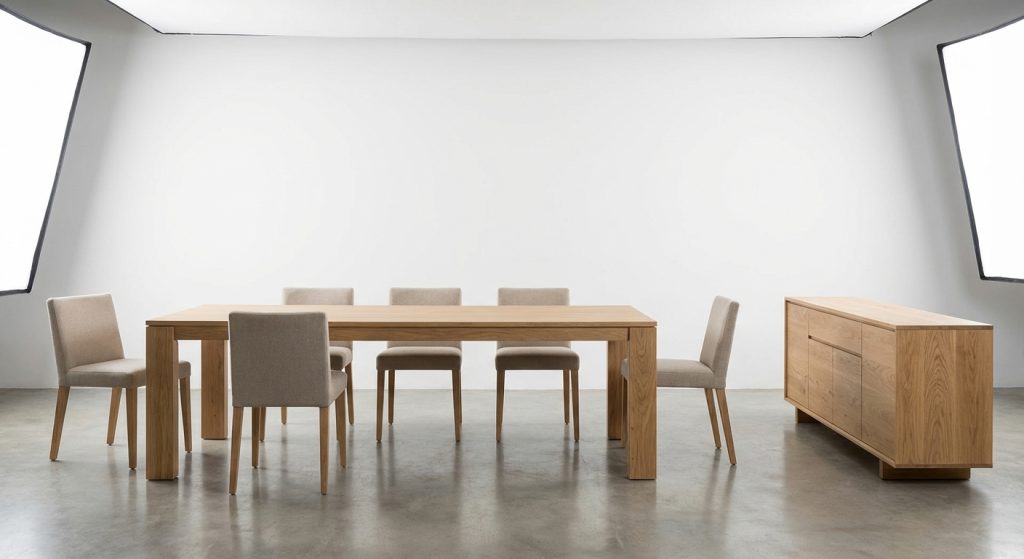
The furniture manufacturing process effectively begins in the design studio, where market trends are translated into manufacturable technical drawings. You need to ensure that your designer’s vision aligns with the factory’s technical constraints to avoid expensive mid-production corrections. This phase is critical because it dictates the final cost-of-goods-sold and determines how well the product will perform in your specific target market.
Aligning Design with Buyer Personas
Your team must synthesize visual trends with the functional requirements of end-consumers to ensure high turnover rates. By prioritizing ergonomic research during the ideation phase, you reduce the risk of structural grey zones that often lead to consumer returns.
Concept Development and Ideation
You should require your design partners to provide 3D renderings that account for grain direction and material stress points.
Here is the truth.
Strategic Design Milestones
Factories that excel in the global market typically follow these structured design milestones to ensure success:
- Comprehensive trend analysis and demographic targeting
- Detailed technical rendering with hardware specifications
- Material stress testing in virtual environments
- Final design approval with production-ready bill of materials (BOM)
Balancing aesthetic appeal with production feasibility is the primary challenge for most emerging furniture brands.
| Feature | Design Focus (Aesthetic) | Production Focus (Functional) |
|---|---|---|
| Material | Visual grain and color | Structural load and stability |
| Joinery | Hidden or decorative joints | Speed of assembly and durability |
| Finish | Gloss level and texture | Resistance to heat and moisture |
Think about it.
Key Takeaway: Strategic design reduces downstream manufacturing errors by aligning market expectations with technical factory capabilities before production starts.
III. Technical Engineering and Materials
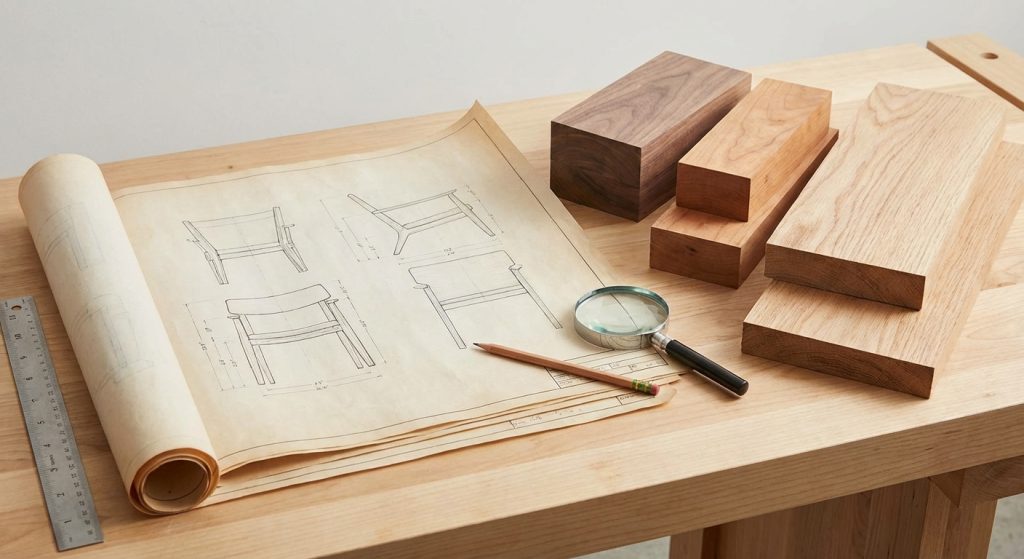
Technical engineering is the stage where you define the structural soul of the product within the furniture manufacturing process. You must carefully evaluate furniture manufacturers to ensure they possess the engineering depth to handle complex wood-to-metal joints or specialized upholstery frames. Selecting the correct grade of timber or engineered board is a decision that balances your retail price point with the expected longevity of the piece.
Material Selection and Grading
You will need to choose between solid hardwoods for premium lines or high-density engineered woods for volume-driven collections. Each choice brings specific unconfirmed gaps regarding expansion and contraction that your engineering team must mitigate through proper joinery.
Engineering for Structural Integrity
If the internal frame lacks proper reinforcement, you will likely face unconfirmed gaps in product safety certifications.
You might be wondering.
Common Furniture Materials
Your procurement strategy should consider the following material categories based on durability and cost:
- Premium Hardwoods (Walnut, Oak, Ash)
- Sustainable Softwoods (Pine, Spruce)
- Engineered Panels (MDF, Marine Plywood)
- Structural Hardware (Stainless steel, Zinc alloys)
Understanding the performance difference between solid wood and engineered alternatives is essential for managing customer expectations.
| Material Type | Solid Wood | Engineered Wood (MDF/Plywood) |
|---|---|---|
| Durability | Extremely High; can be refinished | Moderate; prone to edge damage |
| Cost | Premium price point | Budget-friendly for mass market |
| Stability | Natural expansion/contraction | High resistance to warping |
You might be wondering.
Key Takeaway: Technical engineering ensures that material selection supports the product’s intended use-case and prevents structural failure in the field.
IV. Prototyping for Quality Assurance
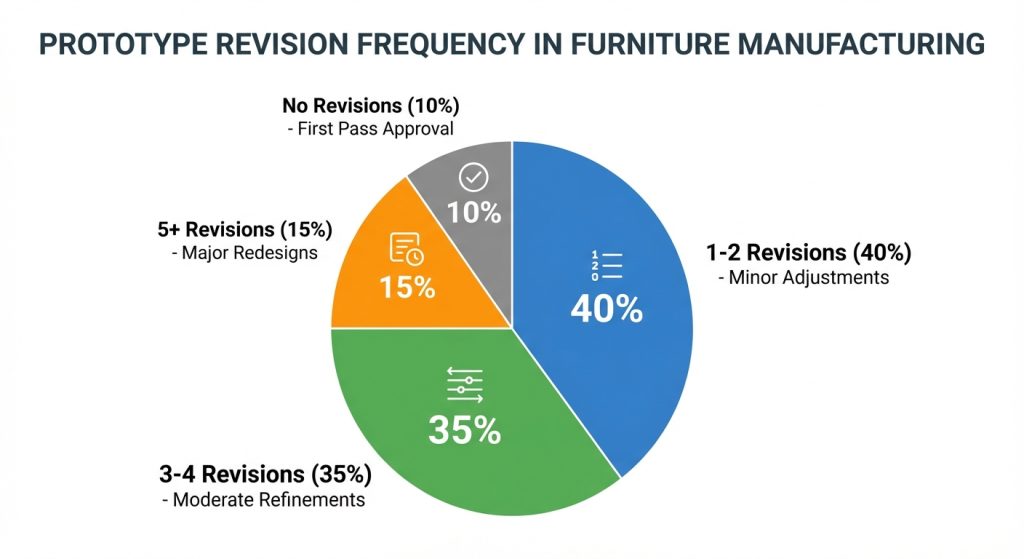
Prototyping acts as the final “fail-safe” mechanism in the furniture manufacturing process before you commit capital to a mass-production run. You should use this phase to physically verify the ergonomics, finish, and structural strength of the design in a real-world setting. Any grey zones discovered here are significantly cheaper to resolve than defects found after thousands of units have been crated and shipped.
Reducing Risks Through Physical Samples
A physical prototype allows you to test the assembly logic of knock-down (KD) furniture to ensure your end-consumers won’t struggle. You can also evaluate the tactile quality of the wood finish to ensure it matches your brand’s luxury or utility standards.
Iterative Refinement and Feedback
You must maintain a strict revision log to ensure that the factory incorporates every requested change into the final production blueprints.
It’s simpler than you think.
Prototyping Checklist for Importers
Ensure your quality team reviews these specific metrics during the final prototype inspection:
- Structural stability under 1.5x the rated load
- Ease of assembly for all hardware components
- Finish consistency across different grain patterns
- Packaging fitment and impact resistance
Our data suggests that most production delays stem from incomplete prototype approvals or unconfirmed gaps in technical specifications.
| Prototype Test | Purpose | Critical Success Metric |
|---|---|---|
| Load Testing | Verify weight capacity | No structural failure at 1.5x load |
| Finish Sample | Check color accuracy | 95% match to master swatch |
| Fit-and-Finish | Assess joinery gaps | Gaps less than 0.5mm |
It’s simpler than you think.
Key Takeaway: Prototyping is your most effective tool for catching design flaws that would otherwise lead to expensive mass-production recalls.
V. Core Production and Wood Processing
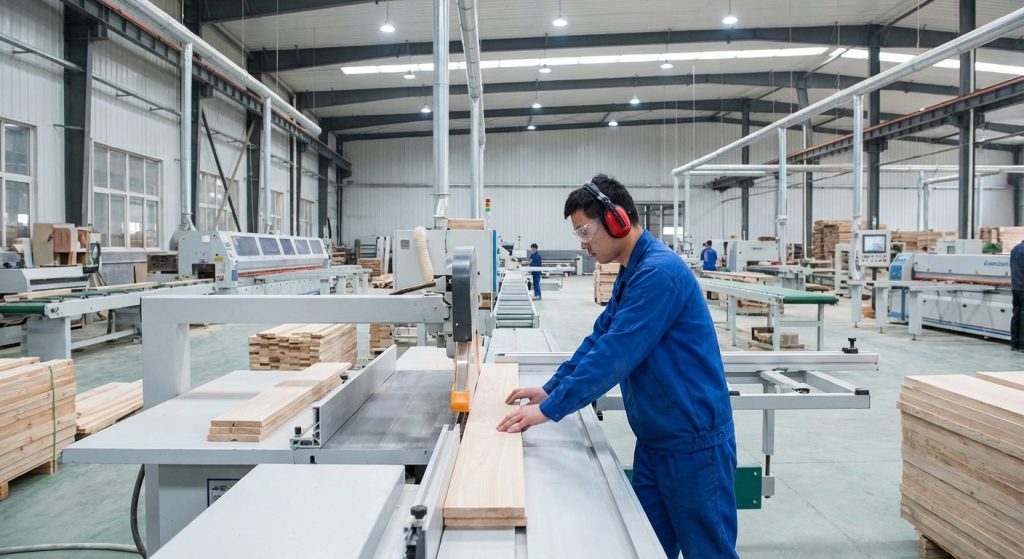
The core production phase is the most labor-intensive part of the furniture manufacturing process, where raw lumber is converted into finished components. When sourcing from China , you should prioritize factories that utilize semi-automated production lines to ensure dimensional consistency. Efficient wood processing relies on precise kiln-drying to prevent future warping, which is a common grey zone in lower-tier manufacturing facilities.
The Production Sequence
You will observe that high-capacity factories move timber through a sequence of sawing, planing, and CNC routing with minimal manual handling. This speed is essential for meeting your quarterly inventory targets while maintaining the tight tolerances required for high-end furniture.
Managing Factory Floor Efficiency
If the factory lacks a digital tracking system, you may experience unconfirmed gaps in your production status reports.
Here is the deal.
Key Production Milestones
Monitor these specific factory floor tasks to ensure your order stays on schedule:
- Initial board ripping and cross-cutting
- High-precision CNC boring and shaping
- Sub-assembly of internal frames
- Final surface sanding and inspection
The following table highlights the critical machinery used to maintain high-volume output without sacrificing part accuracy.
| Production Task | Equipment Used | Quality Indicator |
|---|---|---|
| Wood Cutting | Beam Saws / CNC | Dimensional accuracy within +/- 1mm |
| Component Boring | Multi-drill / CNC | Clean holes without splintering |
| Sanding | Wide-belt / Orbital | Surface smoothness ready for stain |
Here is the deal.
Key Takeaway: A streamlined production phase is critical for maintaining the high-volume output required to support global retail expansion and brand growth.
VI. Professional Finishing and Treatment
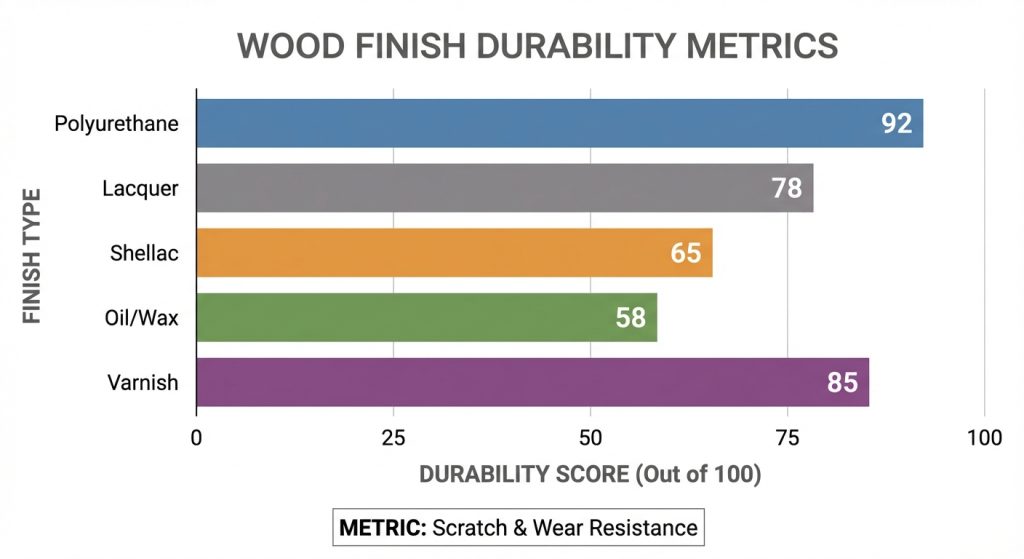
Professional finishing is the stage of the furniture manufacturing process that provides both the visual character and the environmental protection for your products. You must select finishes that meet the safety regulations of your target market, such as California’s Prop 65 or European REACH standards. A high-quality finish hides minor natural imperfections while highlighting the beautiful grain patterns that drive consumer desire.
Protective Coating Selection
You should choose between oil-based, water-based, or UV-cured finishes based on the expected wear-and-tear of the furniture piece. Unconfirmed gaps in coating thickness can lead to premature peeling or staining, which negatively impacts your brand’s perceived value.
Consistency in Multi-Step Finishing
You will find that the best factories utilize dust-free spray booths to ensure that no particles mar the final surface of your furniture.
But that’s not all.
Professional Finishing Techniques
The following steps are essential for achieving a showroom-quality finish on solid wood or veneered products:
- Grain raising and fine-grit final sanding
- Controlled staining for color uniformity
- Multi-layer application of sealers and primers
- High-durability top-coat application (Matte to High Gloss)
Comparing different finish types reveals significant variations in repairability and long-term protection against household liquids.
| Finish Type | Lacquer/Varnish | Natural Oil/Wax |
|---|---|---|
| Protection | High resistance to liquids | Low; requires regular maintenance |
| Aesthetic | Uniform, smooth film | Enhances natural wood texture |
| Repairability | Difficult; requires stripping | Easy to touch up locally |
But that’s not all.
Key Takeaway: The finishing stage is vital for protecting the raw wood and ensuring the product meets international durability and safety standards.
VII. Rigorous Quality Control Standards
Implementing a robust furniture manufacturing process is impossible without a strict quality control (QC) framework. You must verify that your partner uses a furniture quality control system that monitors every stage from raw material intake to final boxing. This prevents defective units from being loaded onto containers, saving you from the logistical nightmare of international returns and unconfirmed gaps in stock availability.
In-Process Inspection Protocols
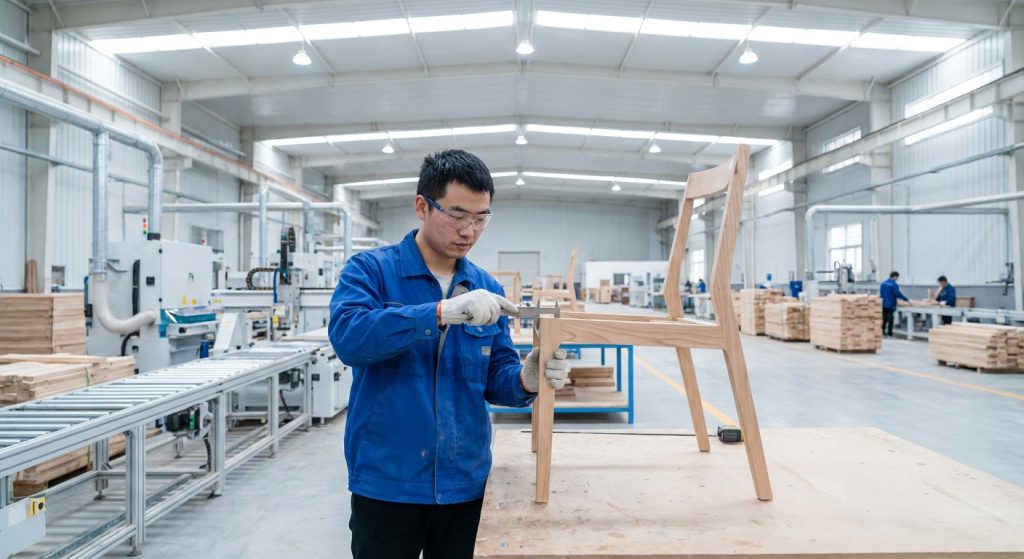
Your QC inspectors should check for dimensional accuracy and moisture levels immediately after the components leave the CNC department. By catching errors mid-stream, the factory can rework parts without delaying the entire batch, effectively closing potential grey zones in the schedule.
Final Visual and Functional Audits
You will need to conduct a random AQL (Acceptable Quality Level) inspection on the finished goods before the factory receives final payment.
Why does this matter?
Standard QC Checkpoints
A professional inspection report should cover these critical areas to ensure compliance with your specifications:
- Moisture content verification (8-12% target)
- Structural joint stability and hardware fitment
- Color matching against the master sample swatch
- Drop testing for the final shipping carton
The data below outlines the standard benchmarks used by high-performance factories to ensure every shipment meets buyer expectations.
| QC Checkpoint | Method | Acceptance Criteria |
|---|---|---|
| In-Coming | Moisture Meter | 8% – 12% moisture content |
| In-Process | Caliper Measurement | Zero deviation from tech specs |
| Final Audit | Visual/Manual | AQL 2.5 standards or higher |
Why does this matter?
Key Takeaway: Rigorous QC protocols protect your brand reputation by ensuring that every shipment meets your specific quality and safety benchmarks.
VIII. Role of Automation in Scaling
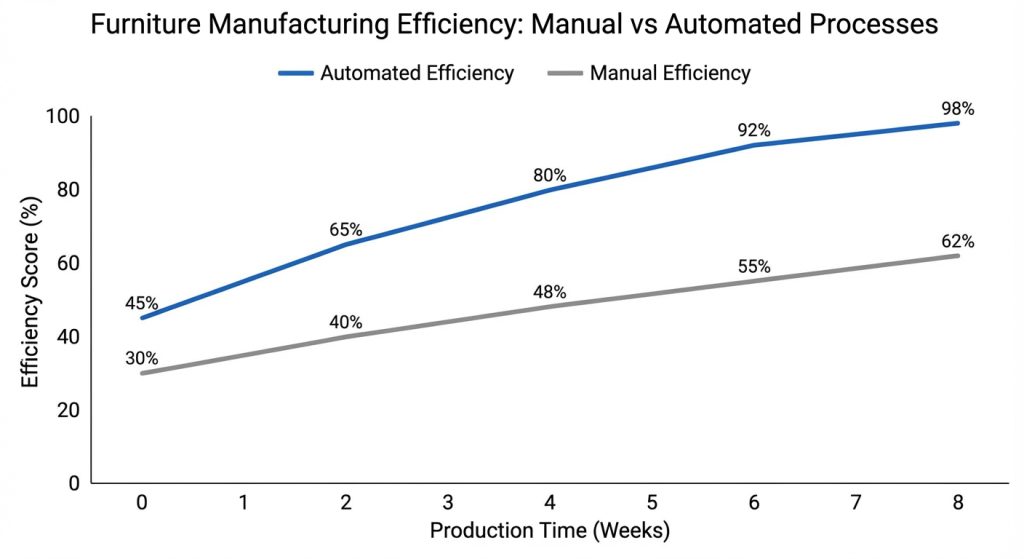
The integration of automation into the furniture manufacturing process is what allows you to move from boutique production to global distribution. Modern CNC machines and robotic sprayers eliminate human error in repetitive tasks, ensuring that unit 1,000 is identical to unit 1. You should look for factories that invest in these technologies to ensure your brand can scale without suffering from unconfirmed gaps in consistency.
Scaling Your Business with Tech
You will find that automated board cutting and edge banding significantly reduce material waste, which lowers your overall unit cost. Automation also improves factory safety, reducing the risk of labor-related grey zones that could halt your production line unexpectedly.
Digital Inventory and Batch Tracking
You should request real-time access to production data to monitor your order’s progress through each automated station.
It gets better.
Advantages of Automated Lines
Factories utilizing high-level automation offer several distinct advantages for growing furniture brands:
- Superior dimensional accuracy for knock-down furniture
- Faster throughput for high-volume seasonal orders
- Reduced reliance on skilled manual labor for simple parts
- Integrated data tracking for better supply chain visibility
The following comparison demonstrates how automation outperforms manual processes in large-scale manufacturing environments.
| Process | Manual Efficiency | Automated Efficiency |
|---|---|---|
| Part Cutting | Low (High Waste) | High (Optimized Nesting) |
| Finish Coating | Variable Consistency | 100% Uniform Application |
| Data Tracking | Prone to human error | Real-time digital accuracy |
It gets better.
Key Takeaway: Leveraging automation is the most effective way for brand owners to achieve price competitiveness while maintaining high-quality outputs at scale.
IX. Sustainable Sourcing for Brand Growth
Sustainability has become a non-negotiable component of the modern furniture manufacturing process for brands targeting conscious consumers. You need to ensure that your factory prioritizes FSC-certified timber and low-VOC finishes to comply with increasingly strict environmental regulations. Ignoring these factors creates unconfirmed gaps in your compliance documentation, which could lead to legal issues or loss of retail partnerships.
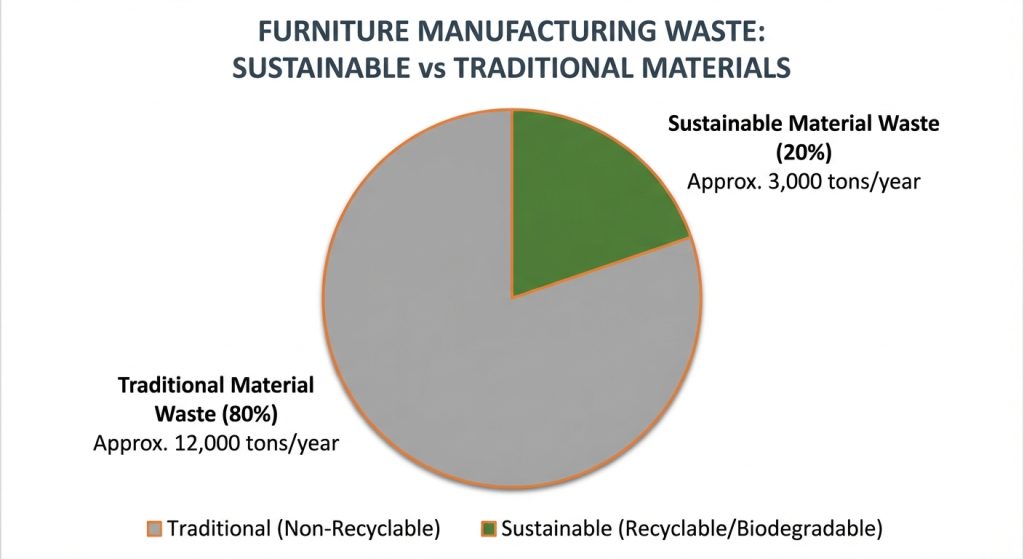
Eco-Friendly Manufacturing Practices
You will find that sustainable factories implement circular waste management systems, turning sawdust and wood scraps into heating pellets or energy. By sourcing timber from responsibly managed forests, you protect your brand against the grey zones associated with illegal logging and environmental degradation.
Certified Materials and Low Emissions
You must verify that the adhesives and coatings used in your furniture do not off-gas harmful chemicals like formaldehyde.
Now, look at this.
Sustainability Performance Indicators
Top-tier sustainable manufacturers focus on these specific metrics to reduce their environmental footprint:
- Percentage of FSC or PEFC certified timber used
- Reduction in water-based finish waste via reclamation
- Use of recycled or biodegradable packaging materials
- Carbon footprint tracking for the entire production cycle
Evaluating your supplier’s commitment to sustainability is essential for building a long-term, ethical brand presence.
| Sustainability Metric | Industry Standard | Excellence Level |
|---|---|---|
| Timber Sourcing | Legal verification | FSC / PEFC Certification |
| Finish Emissions | Solvent-based (High) | Water-based / UV-cured (Low) |
| Waste Management | Landfill disposal | 90% Recycle/Upcycle rate |
Now, look at this.
Key Takeaway: Integrating sustainability into your manufacturing process enhances brand value and ensures long-term compliance with global environmental regulations.
X. Logistics and Delivery Management
The final stage of the furniture manufacturing process is the secure packaging and transit of your finished goods. You must design your packaging to survive the rigors of sea freight and multiple handling points to avoid unconfirmed gaps in your sellable inventory. Proper logistics management ensures that the high-quality furniture you manufactured arrives in your customer’s home exactly as it left the factory floor.
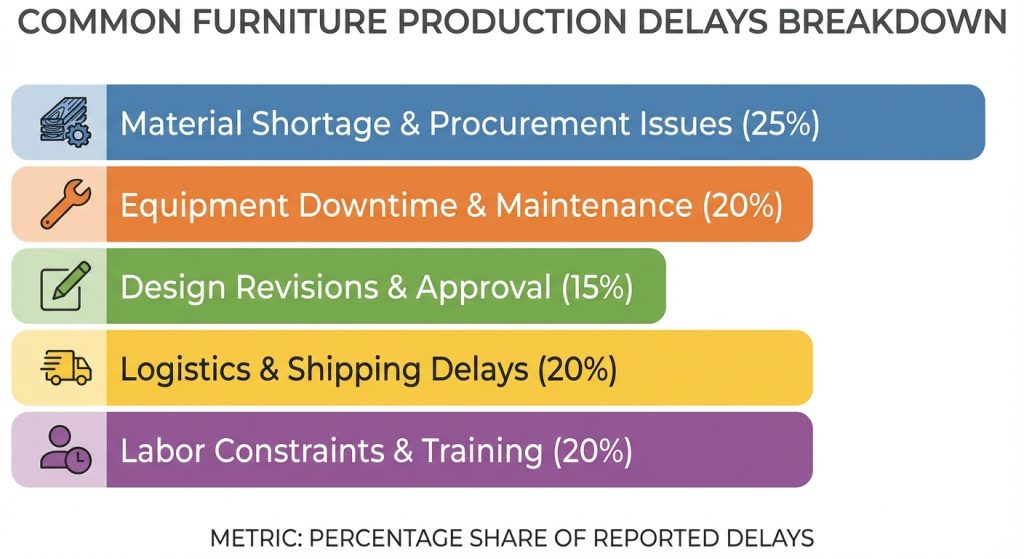
Ensuring Safe Transit of Goods
You should use high-density foam and double-walled corrugated boxes to protect corners and fragile surfaces during long-haul shipping. Unconfirmed gaps in packaging strength often lead to transit damage, which is a major source of hidden costs for international importers.
Efficient Shipping and Documentation
You will need to work closely with your freight forwarder to optimize container loading and ensure all customs documents are accurate.
In short.
Logistics Management Checklist
Your logistics team should verify these final steps before the container leaves the factory premises:
- ISTA-standard packaging and drop test certification
- Detailed container loading plans for maximum stability
- Accurate Bill of Lading and Certificate of Origin
- On-site assembly instruction and hardware kit inclusion
Planning for the final leg of the journey is just as important as the manufacturing steps that preceded it.
| Logistics Step | Action | Benefit |
|---|---|---|
| Packaging | 5-ply Corrugated Boxes | Impact protection during handling |
| Container Prep | Palletization | Faster unloading and reduced damage |
| Documentation | Bill of Lading / COA | Smooth customs clearance |
In short.
Key Takeaway: Effective logistics planning is the final step in ensuring that the high-quality furniture you manufactured arrives in pristine condition for your customers.
Frequently Asked Questions
Can I customize designs during the production phase?
Major design changes are typically not possible once mass production has begun without incurring high costs and delays. It is best to finalize all customizations during the prototyping and engineering stages to avoid unconfirmed gaps in your production timeline.
What’s the best wood for durable furniture?
For commercial-grade durability, hardwoods like Oak, Walnut, and Ash are superior due to their density and resistance to daily wear. For budget-sensitive projects, high-quality Plywood or MDF with solid wood veneers offers a great balance of cost and stability.
How do I verify a factory’s quality standards?
You should request the factory’s ISO certifications, AQL (Acceptable Quality Level) reports from previous shipments, and conduct a third-party audit. A reliable supplier will act as a supporter of buyer confirmation by providing transparent access to their manufacturing logs and QC stations.
Closing Note
Mastering the furniture manufacturing process is the key to maintaining a competitive edge in the global market. At Everwoody, we prioritize precision and sustainable craftsmanship in every piece we produce. Ready to scale your production with a reliable partner? Contact us today to explore our high-capacity manufacturing solutions and elevate your brand’s collection.