
Let’s be honest for a moment.
Most furniture orders don’t collapse because someone made a bad call.
They fall apart much earlier—right after the sample gets approved—when everyone feels the hard part is over.
That moment feels safe. The product looks right. The discussion slows down. Decisions stop moving.
And quietly, responsibility shifts from explicit confirmation to assumption.
This article isn’t here to scare you.
It’s written for buyers who are already in the middle of a real order and want to make sure nothing important is left hanging before production starts.
Think of this as a final walk-through—before the factory locks the plan and the order starts moving on its own.

I. Sample Approval Ends Certainty Earlier Than Buyers Realize
Before we go any further, we need to reset one idea.
Sample approval doesn’t mean the order is “secured.”
It means one layer of uncertainty has been closed—usually the visual one.
Everything underneath that layer still exists, whether it was discussed or not.
1. Visual approval quietly replaces production definition
When buyers approve a sample, they usually approve it for the right reasons.
The size feels right. The finish matches expectations. The product looks sellable.
That’s how most purchasing decisions are made, especially under time pressure.
The problem isn’t that buyers approve on visuals.
The problem is what happens after that approval.
Production doesn’t work on impressions. It works on repeatable decisions:
how parts are joined, how much variation is allowed, which elements are structural and which are cosmetic.
If those decisions weren’t clearly confirmed, production doesn’t pause. It fills the gaps using its standard logic. Not because someone is careless, but because production can’t operate on undefined space.
So the sample you approved becomes a reference, not a rulebook.
This gap shows up often in Kids Furniture, where the visual pass happens fast, but structural definition is assumed to be “obvious.”
It usually isn’t.
2. “Same as sample” is an instruction gap, not a safeguard
“Same as sample” sounds reassuring.
In real production terms, it’s vague.
To a buyer, it often means:
It should feel the same when it arrives.
To a factory, it usually means:
We’ll follow the same BOM logic and production route.
Both interpretations are reasonable.
They’re just not the same thing.
“Same as sample” doesn’t tell anyone how tight a tolerance should be, which elements matter most, or where variation becomes unacceptable. It doesn’t remove decision-making—it postpones it.
Those decisions still get made.
They’re just made later, by whoever is left holding the process.
That’s why issues tied to “same as sample” almost never feel dramatic. They feel subtle. Something is slightly off. Not wrong enough to reject, but not exactly what was expected either.
3. Silence after approval is often the first warning sign
One of the most common early signals isn’t a disagreement.
It’s the absence of follow-up.
When sample approval ends the conversation completely—no clarifications, no edge-case questions—that usually means everyone is assuming the remaining details are “standard.”
They rarely are.
| What was clearly approved | What quietly stayed open |
|---|---|
| Overall dimensions | Internal joint method |
| Finish appearance | Fastener selection |
| General sturdiness | Load tolerance range |
None of these gaps mean the order is doomed.
They just mean the order is now running on interpretation.
And once interpretation starts, it tends to stay invisible—until volume arrives.
II. Scaling Doesn’t Change the Product, It Changes the Decision Pressure
Once production quantity enters the picture, the order stops behaving like a sample.
Not because anyone changes intent—but because the environment changes.
This is where many buyers feel something shift, even if they can’t immediately name it.
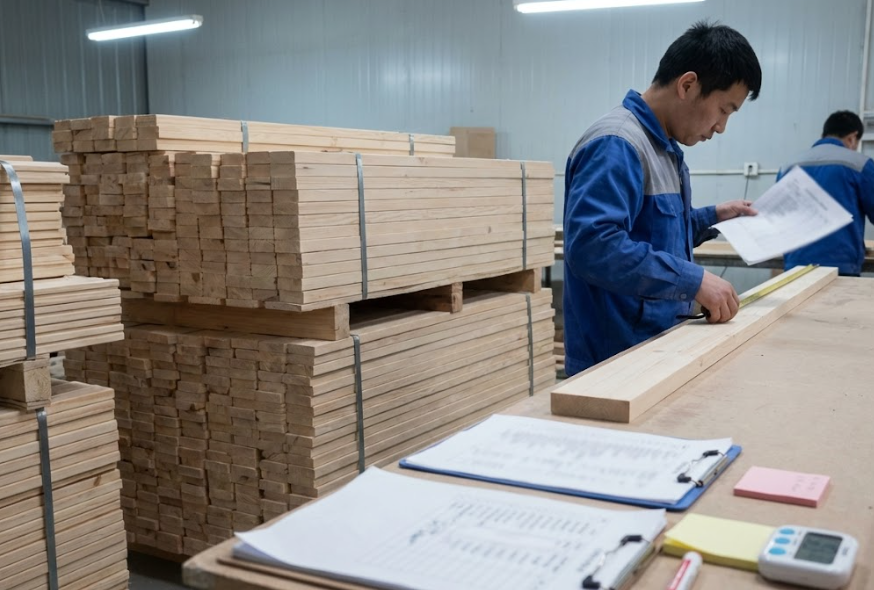
1. Why single samples behave generously
A single sample benefits from flexibility.
If a board isn’t perfect, it can be swapped.
If an edge needs refinement, someone spends extra time on it.
If something feels slightly off, it gets corrected manually.
None of that is a problem. That’s how sampling works.
But production can’t operate this way. It has to protect yield, maintain line rhythm, and keep outcomes consistent across dozens or hundreds of units.
So the product doesn’t change.
The rules around it do.
That difference explains why buyers sometimes say, “The sample felt better,” even when the production units meet specifications.
The sample benefited from attention.
Production relies on definition.
2. Tolerance stays invisible until it repeats
Small deviations don’t announce themselves on a single unit.
A one-millimeter variation is easy to ignore when you’re holding one piece in your hands. When that variation repeats across a batch, it becomes noticeable—not because it’s wrong, but because it’s consistent.
Panels don’t line up quite the same.
Edges feel slightly uneven across multiple units.
Assemblies feel less forgiving.
This isn’t a quality failure.
It’s a tolerance decision that was never consciously made.
That’s why disputes at this stage often feel uncomfortable. Nobody can point to a clear mistake, but something no longer matches the mental image formed during sampling.
3. Which products reveal scaling gaps first
Not all products show these gaps at the same speed.
Items that rely heavily on symmetry, alignment, or visual consistency tend to expose them earlier. The buyer senses the difference before they can measure it.
| Sampling phase | Production phase |
|---|---|
| Individual correction | Statistical average |
| Visual adjustment | Fixed tolerance |
| “Feels right” | “Within range” |
This pattern is especially common in Residential Furniture, where perception plays a major role in how quality is judged.
Scaling isn’t where things go wrong.
It’s where unconfirmed decisions finally show themselves.
III. Material Confirmation Stops at Naming, Not at Behavior
Material is one of those topics that feels settled far earlier than it actually is.
Once a wood type is confirmed, most buyers feel that box is checked.
In practice, it’s only half-checked.
1. Why material labels feel safer than they are
Terms like “solid wood,” “plywood,” or “rubberwood” sound specific.
They’re not operational instructions.
They don’t define moisture range, density spread, lamination logic, or how the material behaves once it leaves the factory environment.
When those parameters aren’t specified, production choices default to what runs stably and predictably within the factory’s system. That’s a rational decision. It just may not align perfectly with what the buyer imagined when approving the sample.
This is why material discussions often feel “done,” until the product arrives and behaves differently than expected.
2. Climate and transit quietly redefine approved materials
Samples are usually evaluated in a controlled setting.
Production units don’t stay there.
They move through containers, humidity shifts, and long transit periods before reaching their final environment. If the target moisture condition wasn’t clearly defined, production can only optimize for stability at origin—not behavior at destination.
That’s not a mistake.
It’s a missing instruction.
The result is a product that may leave the factory in excellent condition and still respond differently once it settles.
3. Finish consistency depends on substrate reality
Even when the same coating system is used, the substrate matters more than many buyers expect.
Finger-jointed panels, mixed-grain boards, and edge-heavy components absorb finish differently. The color formula didn’t change. The surface underneath did.
When a finish variation appears, it’s often described as “inconsistent workmanship.” In reality, it’s the visible outcome of material behavior that was never fully discussed.
This shows up most clearly in Outdoor Furniture, where environmental exposure amplifies small material differences.
Material issues don’t usually feel like errors.
They feel like surprises.
And surprises, in this stage of an order, are rarely welcome.

IV. Packaging Is a Product Decision Disguised as Logistics
Once the product itself feels “settled,” packaging is often treated as a follow-up task.
That’s understandable. It feels operational, not strategic.
In reality, packaging is the first thing that decides whether the product your customer opens still matches the sample you approved.
1. Why sample packaging quietly misleads buyers
Samples almost always travel under better conditions than bulk orders.
They ship alone.
They’re padded generously.
They’re handled carefully.
That creates a false sense of security. The sample arrives clean, intact, and reassuring. It’s easy to assume production units will arrive the same way.
But bulk shipments live in a different world. Cartons are stacked. Weight transfers downward. Vibration repeats for weeks. Humidity doesn’t stay polite.
The issue isn’t that sample packaging is wrong.
It’s that it isn’t representative.
When buyers subconsciously use the sample’s arrival condition as a benchmark, they’re comparing two very different journeys.
2. What “standard export packing” actually decides for you
When packaging details aren’t specified, the factory has to move forward anyway. The phrase that usually fills that gap is “standard export packing.”
That phrase isn’t a red flag.
It’s a placeholder.
It means the factory will choose a solution that works for most products, balances cost, and fits existing logistics routines. That solution may be perfectly reasonable. It just isn’t tailored to your product’s weak points.
Once that decision is made, everything downstream follows it. Carton strength, inner fixation, and stacking behavior are no longer variables. They’re locked.
And if the product arrives with surface marks or internal movement damage, the discussion doesn’t start with what broke.
It starts with what was never defined.
3. Damage patterns almost always point backward
One useful thing about shipping damage is that it’s rarely random.
Edge compression points to carton strength.
Surface scuffing points to internal movement.
Hardware scratches point to fixation logic.
These patterns don’t mean the packaging failed. They usually mean the packaging was never designed for that specific risk.
| Packaging decision made early | Packaging decision left open |
|---|---|
| Predictable arrival condition | Reactive claims |
| Clear responsibility | Blurred accountability |
| Fewer disputes | Repeated adjustments |
This shows up often in Office Furniture, where flat-pack efficiency competes directly with surface protection.
Packaging problems don’t feel technical to buyers.
They feel unnecessary.
V. Assembly Responsibility Is Often Decided Too Late
Assembly is one of those topics everyone assumes is “obvious.”
Until the product reaches the user.
At that point, whatever wasn’t decided earlier becomes very visible, very fast.
1. Factory logic and buyer logic optimize different outcomes
When assembly level isn’t explicitly confirmed, both sides default to what makes sense to them.
Factories tend to optimize for shipping efficiency and consistency.
Buyers tend to think in terms of user experience and ease of setup.
Neither approach is wrong.
The problem is assuming they’re the same.
A product shipped partially assembled may look fine on paper and save freight space. To the end user, it may feel complicated or fragile. A knock-down solution may be efficient in transit but frustrating without clear guidance.
If no one explicitly assigns responsibility for that decision, it gets made by circumstance, not intention.
2. Hardware consistency depends on early clarity
Samples often include a bit of flexibility. Extra screws. Manual alignment. Small adjustments that make everything feel solid.
Production kits don’t work that way. They need exact counts, defined fasteners, and repeatable sequences.
If screw type, length, and order weren’t locked during confirmation, production will standardize them. Again, not because someone is cutting corners, but because consistency requires definition.
When buyers later notice differences in feel or stability, it’s tempting to frame it as inconsistency. In reality, it’s the result of a choice that was never clearly made.
3. Instructions are market-specific, not universal
What feels intuitive on a factory floor doesn’t always translate to the end user.
Assembly instructions that make sense to someone familiar with the product can confuse a customer encountering it for the first time. This isn’t about intelligence or effort. It’s about context.
If instruction format, language depth, or visual clarity weren’t discussed early, they default to whatever has worked before. That may or may not fit your market.
| Undefined assembly detail | What usually follows |
|---|---|
| Assembly level | User hesitation |
| Hardware sequence | Rework or returns |
| Instruction clarity | Support requests |
These issues appear frequently in Educational Furniture, where usability expectations are high and tolerance for confusion is low.
Assembly problems rarely break products.
They break confidence.
Conclusion
If this made you slow down, that’s the point.
After sample approval, the real risk isn’t production.
It’s who is still carrying the unspoken details forward once the order starts moving.
That’s usually what separates a smooth order from a quietly wrong one.
If you’re reassessing that responsibility, start from how we approach orders at EverWoody.